This essay is a book review. It refers to the concise Darwin biography published by Tim M. Berra. Professor Berra is an expert on the life and times of Charles Darwin and his family members. Many heavyweight biographies were published about Charles Darwin, known as the father of the evolution theory who is considered to be one of the most influential persons in the last 200 years.
Professor Berra opens his book by stating that:
“Charles Darwin is among the most influential scientists who ever lived.
We agree with this statement.
The book was published by the Johns Hopkins University Press, Baltimore. 2009, is titled: Charles Darwin The Concise Story of an Extraordinary Man”.
The book is easy and quick to read. It contains many references to Darwin the man, his youth, family and his work. Berra’s popular lecture titled: “Darwin”, was itself a hit in demand in academic circles. More on the book and rich contents is coming down.
With all the hip about Darwin and stories about the Galapagos islands, me and my daughters Hadar and Dafna Lender went on a visit to witness the legendary natural rich and fascinating wildlife and distinctive vegetation that gave Darwin the intellectual material and vigor to craft the Theory of Evolution.
There are way over sixty notable islands in the archipelago. We stayed in four islands: North Seymour, Baltra (where our arrival airport was), Santa Cruz and Isabela Island. The trip was an amazing experience. I brought back 500 photos.
Here are snapshot oddities of what I saw on the Galapagos Islands.
Santa Cruz island seen from above. Puerto Ayora in the center.
The sea lions are used to humans. He didn’t care. Just took the bench over, for himself.
This large tortoise in Santa Cruz is… really large. The carapaces are different in each island.
Iguanas on Santa Cruz island have different colors as a result of… you guessed it – evolution driven by the need to survive.
The marine iguanas are blue-gray blending with sea color. Uniquely evolved. A tiny lizard feeds on its skin.
The terrestrial iguanas evolved yellow-gray to blend with the desert colors.
Dafna and Hadar next to giant cactuses.
Convoluted cactuses. Typical to the Pacific mixed dry-wet climate. Unique to Galapagos.
SallyLightfoot. These distinctive crabs are everywhere on the beaches.
North Seymour Island is known for its unique aviary: Above are a couple of Blue Footed Boobies.
A pair of Frigatebirds nesting on Seymour island.
A Darwin finch. Darwin counted 13 different species of this little bird.
# # #
Back to Professor Berra’s literary biographical gem of Charles Darwin. We are told that the young Darwin (age 22-26 years), brought with him from around the world voyage thousands of flora, fauna and other inanimate specimens. Those served him later, at his home in Downe, as “dots”. Darwin endowed with a formidable intellect and sagacity later connected these “dots” and wove them into the magnificent fabric of Theory of Evolution.
Professor Berra best summarizes Darwin’s theory method. Here it is (minor word omissions for even better clarity):
“Darwin’s patience and keen powers of observation led to the realization that there is variation in nature. No two individuals are alike in a litter of puppies, school of minnow hatchlings, or members of same species of barnacles or orchids. The germinations of seeds from the same plant yield variable offspring. Darwin’s genius was to understand that this over-production was related to variation. He eventually came to realization that there is competition for resources in nature and that the variations best adapted to their environment would displace the less favorably endowed individuals.
Since the environment is doing the choosing, he called this process natural selection, as opposed to the artificial selection imposed by breeders. This resulted in descent with modification. Which was his definition… of evolution. Today we have the benefit of genetic knowledge, which was unknown to Darwin… Descent with modification can be explained as a change in gene frequency that is a change in the proportion of a particular gene variant among all the alternative forms of that gene. Natural selection is differential reproduction. In other words, in the same environment, one form leaves more offspring than another form. The environment is the selecting agent.
Darwin had no knowledge of the source of this variation… change in a gene (mutations). Today we understand that genetic variation is produced by mutation, sexual reproduction, chromosome re-arrangement, etc.
So to recap: Evolution is descent with modification (change in gene frequency), brought about by natural selection (differential reproduction), acting on the variations produced by mutations and other sources, with the environment doing the selecting.”
(Tim M. Berra: “Charles Darwin, the Concise Story of an Extraordinary Man”. P. 68-69.)
And the rest is history.
This book should be teaching material in high schools.
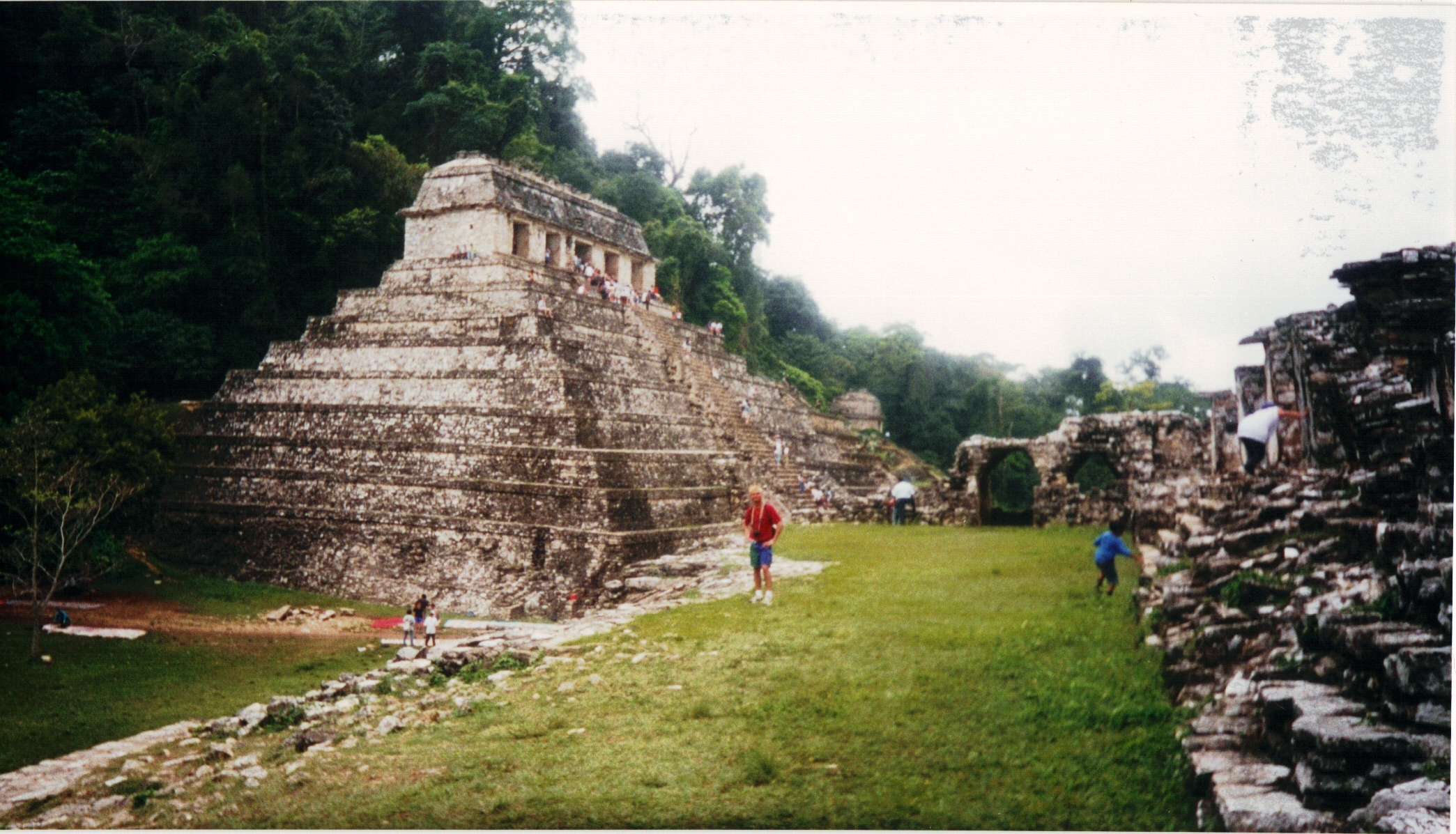
It was the end of March and beginning of April 1999 that Chuck Gillen and me went on an unplanned impromptu trip to the Lacandon rain forest. That is the area of southern Mexico (Chiapas), which is home to the ruins of Palenque, Bonampak and Yaschilan.
We did it with the support service local guides from Palenque which was our base camp. We had the opportunity to sail down on the Usumacinta River that serves as the border between Mexico and Guatemala on our way to Yaschilan.
Chuck wearing red shirt at the court in the ruinas of Palenque.
I’m lost in the Lacandon jungle. I felt scared.
The mooring bank of the Usumacinta River at Yaschilan.
We are being safely escorted by the Mexican federal cops avoiding banditos.
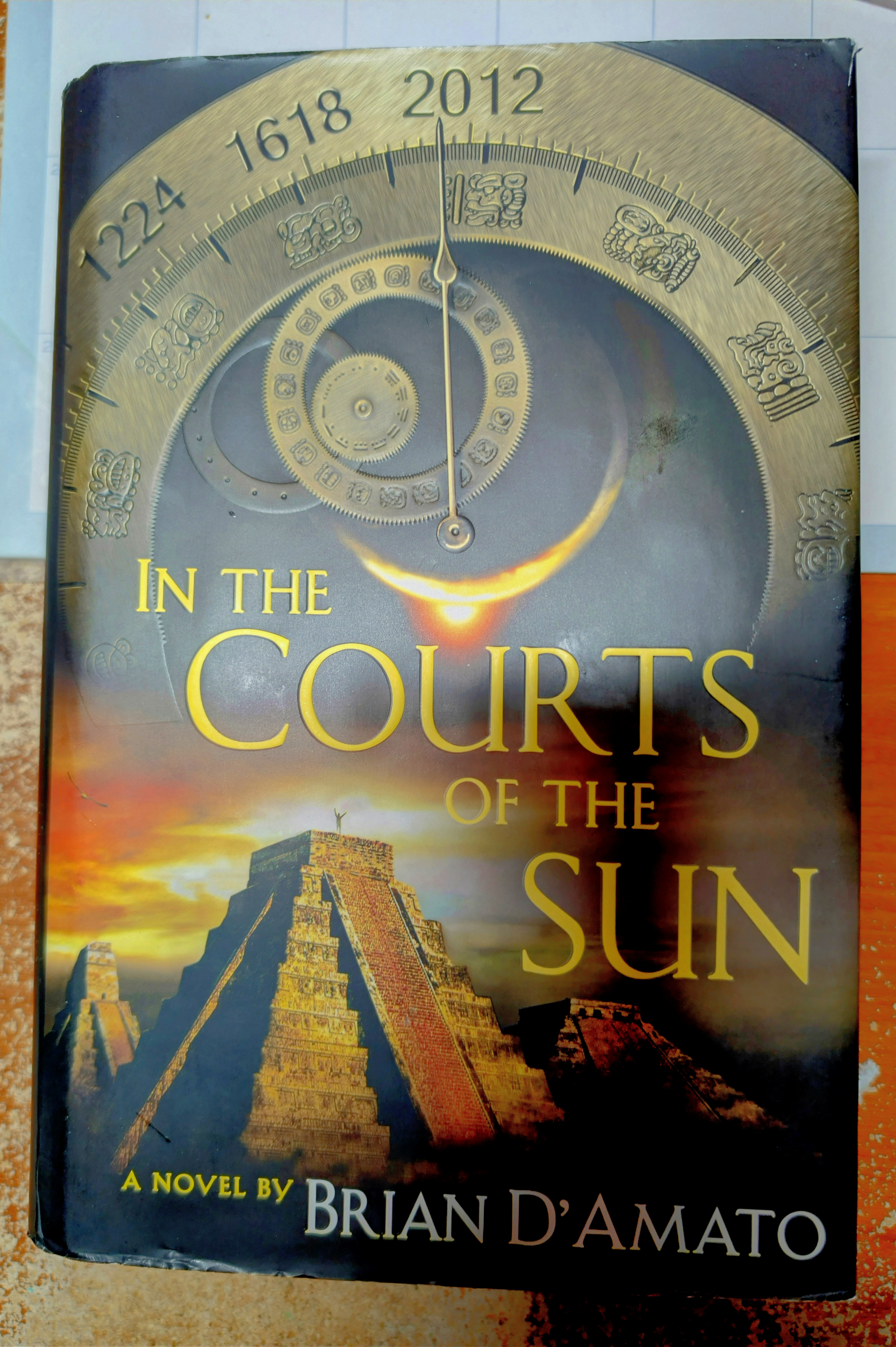
Enters the Renaissance novelist, painter and sculptor, Brian D’Amato who published in 2009 his great fictional historical thriller novel, “In The Courts of The Sun”.
The novelist, painter, and sculptor, Brian D’Amato, a multifaceted artist whose creative endeavors span various disciplines, including literature, visual arts, and sculpture. In 2009, he made a significant mark on the literary world with the publication of his remarkable fictional historical thriller novel, “In The Courts of The Sun.” This captivating work immerses readers in the rich and intricate world of the Maya civilization, specifically during a pivotal period around the year 664 AD, a time characterized by cultural flourishing and political intrigue.
The novel intricately weaves together historical facts and imaginative storytelling, allowing readers to explore the complexities of Maya society, including its elaborate rituals, social hierarchies, and the interplay between the natural and supernatural realms. D’Amato’s vivid descriptions and meticulous attention to detail transport readers to the heart of the Maya world, where they encounter not only the majestic architecture and vibrant landscapes but also the nuanced relationships among its inhabitants. Through the eyes of his characters, the author delves into themes of power, spirituality, and the human condition, revealing how these elements shaped the lives of the Maya people during this fascinating era.
In “In The Courts of The Sun,” D’Amato crafts a narrative that is both thrilling and thought-provoking, as it challenges readers to consider the complexities of history and the ways in which it informs contemporary life. The intertwining of fiction and historical accuracy serves to enrich the reading experience, prompting reflections on the cyclical nature of civilization and the enduring legacies left by cultures long past. With a blend of suspense, adventure, and philosophical inquiry, Brian D’Amato’s work not only entertains but also educates, making it a significant contribution to the genre of historical fiction.
And it all happens in the locales that we actually visited nine years earlier. What a serendipitous encounter with a modern multy-talented artist that is Brian D’Amato.
The novel “In The Courts of The Sun” was published by Dutton,The Penguin Group publishers. NY 2009.
The Legacy of Baruch Lender in Israeli Chess Problems
Emphasizing Baruch Lender’s historical impact within Israeli chess, targeting readers interested in chess history and composition.
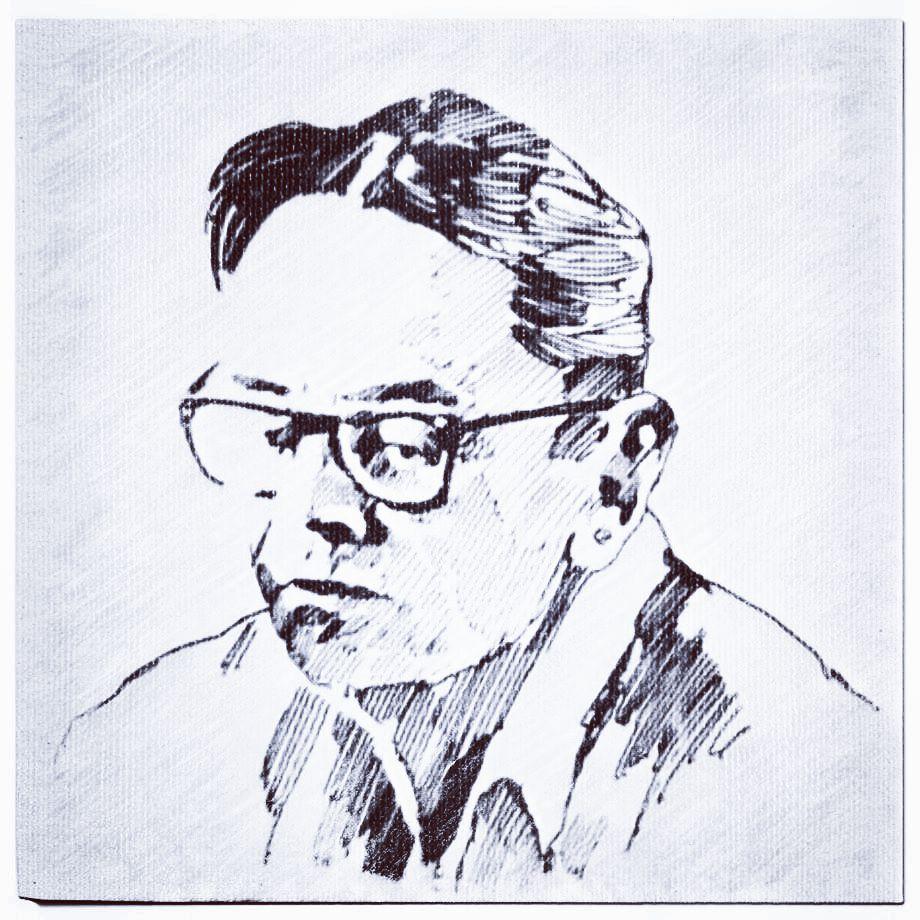
Baruch Lender (9 January 1913 – 25 February 1994) was an Israeli chess problems composer, recognized for his theoretical contributions to the art of chess problems.1 His most enduring legacy is the invention of a complex strategic theme for two-move problems known as the “Lender Combination,” a sophisticated synthesis of pre-existing tactical ideas that cemented his reputation as a profound theorist in the field. While his work was deeply technical, his life was framed by a broader context of intellectual pursuit.
Biography and Context in Israeli Chess Composition
Born on January 9, 1913, Baruch Lender was part of a generation of composers who shaped the landscape of chess composition in Israel. He emerged during what is known as the “Haproblemai Era” (1954–1985), a period of significant growth for the art form in the country, spurred by the popularity of chess columns and specialized publications. This era was foundational, building upon the earliest roots of Israeli chess composition, which can be traced back to 1924, and setting the stage for Israel’s later international successes, including multiple World Chess Solving Championships.
Lender’s contemporaries included notable figures such as Josef Goldschmidt, often regarded as the “father of Israeli chess composition,” who helped foster an environment where complex strategic ideas could flourish. Within this vibrant community, Lender’s contribution stands out for its focused depth. While the historical record provides extensive details on the careers of other Israeli chess figures—such as Ofer Comay, a World Chess Solving Champion, or Yochanan Afek, a prolific composer and writer—Lender is remembered almost exclusively for his single, named thematic invention. This suggests that his impact was that of a quiet, deep thinker rather than a public figure or a prolific composer of varied works. His legacy is not defined by volume, but by the intellectual novelty and intricacy of the Lender Combination, an idea so significant that it became his primary identifier in the annals of chess problem history.
Personal details from his daughter’s memoirs reveal that Lender was an educated man from a family of higher social standing who, by 1939, was a partner in his father’s business. He was described as a gentle and generous person, known for his calm demeanor and an aversion to pointless arguments—a temperament perhaps well-suited to the patient and logical pursuit of chess problem composition.
The Lender Combination
The Lender Combination is a highly complex theme in two-move chess problems, described as a “sort of mix of Salazar and (pseudo) le Grand” themes. Its ingenuity lies in its layering of multiple forms of paradox and reciprocity, creating a deep and challenging solving experience. To fully appreciate Lender’s invention, it is necessary to first understand its constituent thematic precursors.
Thematic Precursors: The Salazar and le Grand Themes
The intellectual architecture of the Lender Combination rests on two sophisticated themes developed in the 20th century, both of which play with the solver’s expectations by reversing the function of moves between different phases of play.
The le Grand Theme
Developed in the 1950s by Dutch brothers Henk and Piet le Grand, this theme involves a paradoxical reciprocal change between a “try” (a near-solution defeated by a single defense) and the “key” (the actual solution). The formal structure is as follows:
A white try threatens a specific mate, $A$.
A black defense, $x$, defeats the threat but allows a different mate, $B$.
The white key move then threatens mate $B$.
The same black defense, $x$, now defeats this new threat but allows the original mate, $A$.
The core of the theme is a “double paradox”: the black defense $x$ appears to both enable and disable each of the white mates, depending on the context of the try or the key.8 This intricate logical reversal makes the theme highly prized among composers.
The Salazar theme is another form of reciprocal change, this time involving the reversal of White’s first and second moves against the same black defense. Its abstract structure is:
A white try, $1. E?$, is met by a black defense, $1…b$, which is followed by the mate $2. F\#$.
The white key move is $1. F!$. When met by the same black defense, $1…b$, it is now followed by the mate $2. E\#$.
Here, the move that served as the mate in the try phase ($F$) becomes the key move in the solution, and the move that was the try ($E$) becomes the mating move. This theme often involves a strategic shift in how the mate is delivered, for instance, by changing between battery and non-battery play.
Lender’s conceptual leap was not merely to use these themes, but to recognize their shared architectural foundation in logical reversal and reciprocity. He understood that these two distinct forms of paradox could be layered upon one another to create a new, more complex structure of strategic misdirection.
Definition and Strategic Structure
The first Lender Combination 1979.
The Lender Combination synthesizes these elements into a single, cohesive whole. Its abstract formula, as demonstrated in Lender’s compositions, can be expressed through the interplay of moves across the problem’s virtual (try) and actual (solution) phases.
A generalized structure is:
Try: $1. A?$ (threatening $2.B\#$). A defense $1…a$ is met by $2.C\#$.
Solution: $1. C!$ (threatening $2.D\#$). The same defense $1…a$ is now met by $2.A\#$.
In this structure, the move $C$, which was a mating move in a variation of the try, becomes the key move of the problem—a clear echo of the Salazar theme. Simultaneously, the move $A$, which was the try itself, becomes the new mating move after the defense $1…a$, reflecting the reciprocal change characteristic of the le Grand theme. The “pseudo” qualifier often used to describe the le Grand element indicates that Lender’s application may modify the pure form to fit within this more complex matrix.
Illustrative Masterpiece: UV CSZTV, 1979
The canonical example of the Lender Combination is his problem published in UV CSZTV in 1979, for which he received a 3rd Honorable Mention.1 A detailed analysis reveals the theme’s intricate mechanics.
Baruch Lender, UV CSZTV, 1979
3rd Honorable Mention
Mate in 2
The solution unfolds across three phases of play:
Set Play (analyzing potential mates if Black were to move first from the diagram position):
$1…Bxd4[a] \quad 2.Qxa6\#$
$1…Bc3 \quad 2.Ne3\#[A]$
The Try:
The try is $1.d5?$, which threatens $2.Ne3\#[A]$.
After the defense $1…Bxd4[a]$, the mate is $2.Qxa6\#$.
After $1…Rc3/Bxa3[b]$, the mate is $2.Rg4\#[C]$.
However, the try is refuted by the single move $1…Re2!$.
The Solution (Key):
The key is $1.Rg4[C]!$, which threatens $2.Qxa6\#$.
After the defense $1…Bxd4[a]$, the mate is now $2.Ne3\#[A]$.
After the defense $1…Bxa3[b]$, the mate is now $2.d5\#$.
The analysis shows how all the thematic elements converge. The key move, $1.Rg4!$, was a mating move ($C$) in a variation of the try. The try move, $1.d5?$, becomes a mating move ($D$) in a variation of the solution. This mutual exchange of functions between the first and second moves is the Salazar component. Meanwhile, the mates following the thematic defense $1…Bxd4[a]$ are changed between the try phase ($2.Qxa6\#$) and the solution phase ($2.Ne3\#[A]$), demonstrating the reciprocal change at the heart of the le Grand theme.
The following table visually deconstructs this complex interplay:
Phase of Play
Threat (Label)
Black’s Thematic Defense (Label)
White’s Mating Response (Label)
Set Play
–
–
$1…Bxd4 [a]$
$2.Qxa6\#$
–
–
$1…Bc3$
$2.Ne3\# [A]$
Try
$1.d5?$
$2.Ne3\# [A]$
$1…Bxd4 [a]$
$2.Qxa6\#$
$1…Bxa3 [b]$
$2.Rg4\# [C]$
Solution
$1.Rg4! [C]$
$2.Qxa6\#$
$1…Bxd4 [a]$
$2.Ne3\# [A]$
$1…Bxa3 [b]$
$2.d5\#$
Family and Personal Life
Beyond his contributions to chess, Baruch Lender was a family man whose children both went on to achieve considerable success in demanding intellectual fields. Their careers and recollections provide a fuller picture of the environment in which Lender pursued his esoteric hobby. Aside from his Chess problems artistic creations he was a successful stock market investor.
Daughter: Professor Minna Rozen
Baruch Lender’s daughter, Minna Rozen (b. October 1947), is a distinguished academic and professor emeritus of Jewish History at the University of Haifa. She is a leading authority on the history of Jews in the Ottoman Empire and the Balkan states, having served as the Director of the Diaspora Research Center at Tel Aviv University from 1992 to 1997. Her scholarly approach is noted for its interdisciplinary nature and its focus on “grassroots history,” which has involved her leading extensive field projects to document and digitize tens of thousands of Jewish gravestones and community archives in Turkey and Greece. In her memoir, Memories from the Pale of Settlement, Rozen offers a warm and insightful portrait of her father. She describes him as “the finest, gentlest, most generous man in the world”. She recalls her fathers as calm and educated nature, noting that he was confident his intellectual abilities would always allow him to provide for his family. A particularly telling recollection is that her father “never wasted time on arguments that led nowhere and was known in town as someone who could not be engaged in a good quarrel.”
Son: Dr. Mandy (Menahem) Lender
Baruch Lender’s son, Dr. Mandy (Menahem) Lender, also pursued a professional career requiring extensive education. Born in Israel, graduated from the Hebrew University Medical School in Jerusalem in 1970 with an M.D. degree and went to earn an MBA degree from the Dominican University, River Forest IL. Later he authored the book The Master Attractor.
The high-level professional achievements of both of Lender’s children—one a leading historian, the other a physician and author—point to a family environment that valued education and intellectual development.
Legacy and Recognition
Baruch Lender’s contributions have been formally recognized and preserved by the chess composition community, ensuring his work remains a subject of study. This posthumous treatment marks his transition from a skilled composer to a canonical figure in the theory of chess problems.
A definitive monograph on his work was published: Lender Combinations – Baruch Lender and His Chess Problems (1996). The book was compiled by a trio of esteemed Israeli composers—Uri Avner, Paz Einat, and Yoel Aloni—a collaboration that signifies the high regard in which Lender was held by his peers. Published by Variantim in both English and Hebrew, the 176-page volume contains 148 of his problems along with personal notes and commentary, making his specialized work accessible to an international audience. Such a scholarly codification by leading experts is a formal acknowledgment of a composer’s lasting importance.
His memory is also actively celebrated. On the occasion of his 100th birthday, the 2nd Israel Open Chess Problem Composition Tourney (c. 2013-2014) dedicated its helpmate section to his memory. This act of communal remembrance ensures that his name and contributions are passed down to a new generation of composers. Together, the scholarly monograph and the centennial tournament demonstrate that the chess problem world has judged Baruch Lender’s work to be of enduring theoretical and historical value.
At the NVIDIA GTC 2025 keynote, Jensen Huang outlined the company’s pivotal role in advancing America’s AI infrastructure, boasting $500 billion in orders for new platforms. Key innovations include Blackwell and Rubin systems, partnerships for AI supercomputers, and advancements in AI, 6G, and quantum computing, driving NVIDIA’s market valuation to $5 trillion. Here are some detailed notes and conceptual analysis of Jensen Huang’s keynote address at the NVIDIA GTC in Washington, D.C., on October 28, 2025.
Oh, wait… GTC stands for: GPU Technology Conference in the next Industrial Revolution. Jensen Huang is the High Priest of this conference. The conference is a major platform for unveiling new Nvidia technologies and setting the direction for future advancements in AI and computing.
Detailed Summary of GTC Keynote (October 28, 2025) The keynote, themed around “America’s AI Infrastructure” and the “Next Industrial Revolution.” It was a strategic presentation focused on NVIDIA’s role in building national AI capabilities.
The central business announcement, which subsequently propelled NVIDIA to a $5 trillion market capitalization, was Huang’s statement that the company now has “visibility into half a trillion dollars” ($500 billion) in cumulative orders for its Blackwell and upcoming Rubin platforms through 2026.
Here are the key points by category:
1. Next-Generation Platform Roadmap (The “One-Year Rhythm”) Huang reaffirmed NVIDIA’s aggressive one-year release beat, moving beyond the chip to full-platform co-design.
Blackwell ( – Current Generation): The Grace Blackwell platform (e.g., GB200 NVL72) is in full production at facilities in the U.S. (Arizona), reinforcing the “Made in America” theme. The Blackwell Ultra chip will be released later in 2025. (Not much time left).
Vera Rubin ( – Next Generation): The next major platform, named after the astrophysicist Dr. Vera Rubin, is scheduled for 2026. This is not just a GPU but it is an entire system architecture.
(Vera Rubin was an American astronomer whose work provided convincing evidence for the existence of dark matter.)
The Full Roadmap In Short: 2025 (2H): Blackwell Ultra 2026 (2H): Vera Rubin (including the Vera Rubin Superchip, CPX Compute Tray, and BlueField-4 DPU) 2027 (2H): Rubin Ultra
2. U. S. National AI Infrastructure & Supercomputing
This is a core theme, positioning NVIDIA as a national strategic asset.
U.S. Department of Energy (DOE) Partnership: NVIDIA announced it is powering seven new AI supercomputers for the DOE. “Solstice” Supercomputer: The largest of these, built in partnership with Oracle, will be one of the world’s most powerful AI systems, featuring 100,000 NVIDIA Blackwell GPUs to support national security, energy, and science applications. Los Alamos National Lab (LANL): The LANL’s next-generation systems will be among the first to be built on the upcoming Vera Rubin platform.
3. New Frontiers: 6G and Quantum Computing Huang detailed NVIDIA’s expansion into two new, highly complex compute domains. 6G Telecommunications:
Hello – Nokia Partnership: A $1 billion strategic partnership with Nokia to develop an “AI-native 6G” platform. NVIDIA Arc Aerial RAN Computer: A new, 6G-ready computing platform designed to infuse AI services directly into the mobile network. (For me and you…)
“All-American AI-RAN Stack”: A collaboration with T-Mobile, Cisco, and MITRE to build a U.S.-based 6G development stack.
Quantum Computing: NVIDIA NVQLink: A new interconnect architecture designed to bridge the gap between classical and quantum computing. It allows NVIDIA GPUs to be directly linked to Quantum Processing Units (QPUs), enabling a hybrid quantum-classical system for complex simulations.
4. Physical AI (Robotics & Autonomous Systems) Huang declared “Physical AI” as the next major wave, where AI agents perceive and interact with the physical world.
NVIDIA “Groot N1” Foundation Model: A new, general-purpose foundation model for humanoid robots. Newton Simulation Platform: A new high-fidelity physics engine (an evolution of Omniverse) designed to simulate robots and their environments for training. “Project Blue”: A collaborative humanoid robot project demonstrated with partners Google DeepMind and Disney Research.
Autonomous Vehicles: Uber Partnership: A major partnership to deploy 100,000 autonomous robotaxis, powered by NVIDIA DRIVE, starting in 2027. DRIVE Hyperion Platform: Expanded adoption by automakers including GM, Stellantis, Lucid, and Mercedes-Benz.
5. Geopolitical and Market Context Hey, there is money to be here…
$5 Trillion Valuation: The keynote’s $500B order visibility statement was the primary catalyst for NVIDIA’s stock surge, making it the first company to achieve this valuation. China Market: NVIDIA’s market share in China has fallen from 95% to “effectively zero” due to U.S. export controls and Beijing’s policies.
“America First” Alignment! Huang explicitly praised the Trump administration’s “America First” policies for incentivizing and revitalizing U.S. manufacturing, which he stated enabled NVIDIA’s new U.S.-based production.
Here are PhD-Level Lecture Notes and Conceptual Analysis of All That Said Below are the core theoretical theses presented by Huang, abstracted from the product announcements.
Thesis 1: The End of Classical Scaling Paradigms Concept: The death of Moore’s Law and, more importantly, Dennard Scaling (which stated power density remains constant as transistors get smaller) is now an accepted industry fact. Argument: Sequential processing (CPU-centric) can no longer deliver the performance gains required. The only path forward is Accelerated Computing, a hybrid model where parallel processors (GPUs) work in tandem with sequential processors (CPUs). Evidence: The entire keynote was a demonstration of this thesis. The core software foundation, CUDA-X, is the “operating system” for this new computing model, and every new hardware platform is designed to accelerate this specific paradigm. (you need to follow the link if you want to get an idea what is CUDA)
Thesis 2: The New Computing Model: “Generative” vs. “Retrieval” Concept: Huang articulated a fundamental shift in the purpose of computing. Retrieval Computing ( – The Past): The old internet and all prior computing were based on retrieval. A user requests information, and the system fetches a pre-written, pre-stored piece of data (a webpage, a document, a video). Generative Computing ( – The Future): The novel AI models do not retrieve. They receive a prompt, understand the context and meaning, and generate a novel, never-before-seen answer (a “token”). (Hello Agentic…) Financial Implication: This new model is computationally far more expensive and requires a new infrastructure. The basic unit of this new infrastructure is the “AI Factory.”
Thesis 3: The New Scaling Law: “Extreme Co-Design” A new Concept is born: If single-chip performance (Moore’s Law) is no longer the primary driver, gains must come from a new scaling law.
Huang’s Law is: “Extreme Co-Design.” Argument: Performance “X-factors” (multiplicative gains) are now achieved by co-designing the entire stack as a single product. This includes: Silicon: The GPU and CPU (Grace Blackwell). Interconnects: High-speed chip-to-chip links (NVLink). (NVLink means providing high speed connectivity between two GPUs to increase performance). Networking: The data center fabric (Spectrum-X Ethernet). Power & Cooling: Liquid-cooling and power delivery systems. Software: Optimized libraries (CUDA) and inference engines (NVIDIA Dynamo). Evidence: The Grace Blackwell NVL72 is the canonical example. It’s not sold as 72 separate GPUs but as a single, liquid-cooled “thinking machine,” a single computational unit. The Vera Rubin platform continues this by integrating the BlueField-4 DPU directly into the system design.
Thesis 4: The Next Wave: From Digital AI to “Agentic & Physical AI” Concept: Huang defined the next evolution of AI. Agentic AI: Ha… It’s the AI that possesses all that ai agency. Can do. BUT it can perceive its environment, understand the context, reason, create a plan, and act to accomplish a goal. You can find some more on Agentic here. Physical AI: The application of Agentic AI to the physical world, which is robotics. Argument: To create Physical AI, models must be trained to understand physics, 3D space, and cause-and-effect. Evidence: This thesis justifies the new product stack: Groot N1: The “brain” or foundation model for the robot. Newton: The “gym” or virtual world where the brain is trained (via simulation and reinforcement learning) before being deployed in the physical world.
Thesis 5: The Software-Defined Physical Stack (6G & Quantum) Concept:NVIDIA’s strategy is to turn specialized, hardware-defined industries into software-defined ones running on NVIDIA GPUs. Argument (6G): A 5G/6G base station is currently a complex box of fixed-function hardware (ASICs, FPGAs). The NVIDIA Arc platform turns it into a software-defined radio (SDR) running on a GPU. This allows telcos to push AI services (like AI-RAN) to the network edge as a software update. Argument (Quantum): Quantum computers (QPUs) are brilliant at certain problems but useless at others. The NVQLink interconnect treats the QPU as a “quantum accelerator” in the same way a GPU is a “parallel accelerator,” allowing developers to write hybrid algorithms (within CUDA) that pass workloads between the CPU, GPU, and QPU.
A video from NVIDIA’s YouTube channel provides the full keynote address from GTC in Washington, D.C., where these notes were made.
Subscribe to this blog. Its free.
My Take If you understand Huang’s Law of “Extreme Co-Design,” and you understand where Agentic AI is going you get a sense on how close we are to AGI.
Elon Musk’s ambitious AI-powered Wikipedia rival, Grokipedia, is reportedly on the edge of its initial release.
Following Musk’s announcement on October 5, 2025, that a “version 0.1 early beta” would be available in two weeks, the tech world is keenly awaiting the first look at the platform developed by his artificial intelligence company, xAI.
So far there have been no official announcements confirming the beta’s public availability. However, the initial timeframe provided by Musk has arrived, suggesting a release is imminent.
Why Does it Matter?
Grokipedia is positioned as a direct competitor to Wikipedia, with the primary goal of addressing what Musk perceives as inherent biases and inaccuracies on the crowd-sourced encyclopedia. The core of Grokipedia will be powered by xAI’s Grok, a conversational AI designed to analyze a vast array of information, including existing Wikipedia articles, to identify and rectify perceived falsehoods and omissions.
The stated aim is to create a more objective and truthful knowledge base. According to early descriptions, Grok will be tasked with discerning the veracity of information and rewriting content to present a more comprehensive and unbiased perspective.
The Doubters:
The prospect of an AI-driven encyclopedia was met with a degree of skepticism. Critics have raised concerns about the potential for algorithmic bias. They question if an AI developed under a specific ideological framework can truly be impartial. The success and impact of Grokipedia will depend on the transparency of its data sources, the sophistication of its AI in handling nuanced topics, and its ability to gain the trust of a broad user base.
At present, concrete details about the beta version, including its accessibility and features, remain limited. Will the initial release will be open to the public or limited to a select group of testers? Also unknown.
Subscribe to this blog site. Its Free. Will always be free.
“Bias is a disproportionate weight in favor of or against an idea or thing, usually in a way that is inaccurate, closed-minded, prejudicial, or unfair. Biases can be innate or learned.
I was inclined into the topic by a recent article in the N.Y. Post titled: “Wikipedia bias influences how ones perception of reality is perceived.”
A disclaimer: I was so far, a charitable contributor to the Wikimedia Foundation. That is the not for profit organization owning Wikipedia. Thus, I realized some questions about the organization over time.
Is Wikipedia biased?
The answer to Wikipedia biases question isn’t a simple “yes” or “no.” The core tension of Wikipedia is a battle between a neutral ideal and the messy reality of human nature.
Below is a tabulation of some evidence, gathered from policies, historical controversies, academic studies, and internal community discussions.
The Wikipedia Bias & Accuracy Ledger
Wikipedia is Never Biased (The Ideal & The Mechanisms)
Wikipedia is Sometimes Biased (The Reality & The Challenges)
The Pursuit of Accuracy (“Wikipedia is Always Right?”)
Core Policy: Neutral Point of View (NPOV)
Systemic Demographic Bias
Self-Correction is Extremely Rapid
The foundational principle. NPOV mandates that articles must represent “fairly, proportionately, and, as far as possible, without editorial bias, all of the Significant views that have been published by reliable sources.” It’s not about finding a middle ground; it’s about describing the full spectrum of sourced views and giving them due weight. For example, on the topic of the Earth’s shape, the scientific consensus is given overwhelming weight, while the flat-Earth view is presented as a fringe belief, which is a correct application of NPOV.
Studies consistently show the editor base is overwhelmingly male (around 85-90%), white, and from North America and Europe. This “systemic bias” results in predictable outcomes: • Coverage Gaps: Far more detailed articles on topics of interest to this demographic (e.g., military history, video games) than on topics like feminist art, African literature, or traditional crafts. • Subtle Framing: Biographies of women are more likely to mention their marital status or family than biographies of men.
A famous 2005 study by the journal Nature found that Wikipedia’s accuracy on scientific articles was “surprisingly good” and approached the level of like the Encyclopædia Britannica. While errors existed in both, Wikipedia’s power was in its ability to fix them. Vandalism and simple factual errors on popular pages are often corrected within minutes, sometimes seconds, by automated bots (like ClueBot NG) and vigilant human editors.
Policy: Verifiability, not Truth
Coverage Bias & Notability Standards
The Power of Citations
This is a crucial, often misunderstood, policy. Editors are forbidden from adding their own opinions or original research. Every substantive claim must be attributable to a published, reliable source. This acts as a powerful brake on individual bias. An editor cannot simply write “Politician X is corrupt.” They must write, “The New York Times reported that Politician X was under investigation for corruption,” and provide a citation. The bias is thus shifted from the editor to the source, which can then be evaluated.
The “notability” guidelines (what merits an article) often favor subjects well-covered in Western, English-language media. A groundbreaking scientist from a non-Western country whose work was published in non-English journals may fail the notability test, while a minor reality TV star with numerous articles in English-language tabloids gets a lengthy page. This isn’t malicious bias; it’s a structural bias baked into sourcing requirements.
The requirement for citations means an interested reader can always check the sources for themselves. This transparency is a key part of the “accuracy” model. A statement in a traditional encyclopedia must be taken on faith; a statement on Wikipedia can be traced back to its origin. This makes it a fantastic starting point for research, if not the endpoint.
Mechanism: Talk Pages & Consensus Building
Conflict of Interest (COI) & Paid Editing
Biographies of Living Persons (BLP) Scrutiny
Every article has a “Talk” page, a forum for editors to debate content, sources, and wording. Contentious edits are often discussed at length. The goal is to reach a consensus based on policy, not to win a vote. This process forces editors with opposing biases to find a neutral way to present information that all can agree on, or at least accept.
Despite policies against it, undisclosed paid editing is a persistent problem. PR firms, corporations, and political campaigns have been caught “scrubbing” articles of negative information or inserting promotional content. This is a direct injection of extreme bias. Wikipedia has volunteer groups and policies to combat this, but it’s an ongoing battle against well-funded actors.
Following the 2005 John Seigenthaler controversy (where a user falsely implicated him in the Kennedy assassinations), Wikipedia instituted extremely strict sourcing standards for information about living people. Un- or poorly-sourced contentious material in a BLP article is subject to immediate removal. This makes articles on living people some of the most scrutinized on the site.
Mechanism: Transparency & Edit History
Ideological Edit Wars
Errors are Inevitable, but Not Permanent
Every single change made to an article is publicly logged and attributable to a user (or an IP address). Anyone can view the entire history of a page, see who added what information, and when. This radical transparency creates accountability and makes it difficult for a single biased viewpoint to take hold secretly.
On highly contentious topics (e.g., Israel-Palestine conflict, U.S. politics, GMOs), articles can become battlegrounds. Groups of ideologically-motivated editors may try to “own” an article, systematically removing information that contradicts their worldview and emphasizing information that supports it. This leads to biased “forks” of in article or long-term stalemates where the page reflects the view of the more persistent editing faction, not a true neutral point of view.
No encyclopedia is perfect. The key difference is the speed of correction. A factual error printed in a book in 2020 will still be there in 2025. A factual error on a high-traffic Wikipedia page is unlikely to survive a day. However, errors on obscure, low-traffic pages can and do persist for years. Therefore, “accuracy” is highly variable depending on the article’s popularity.
Now then, I return from the review journey with this impression:
Is Wikipedia Never Biased? The answer is false.
Wikipedia is written by biased persons. The writers/authors/scribes use sources that are themselves biased, and are subject to the systemic biases of the society the sources emerge from. The very structure of what is considered “notable”, worthy of inclusion as an entry, or in the text, is a form of bias.
2. Is Wikipedia Sometimes Biased?
This is demonstrably true. Wikipedia is sometimes biased. The evidence of demographic, coverage, and conflict-of-interest bias is overwhelming and acknowledged by the Wikimedia Foundation itself, which works to combat it through initiatives like edit-a-thons focused on underrepresented topics.
3. Is Wikipedia “Always Right”?
This is false. Wikipedia is not a source of ultimate truth, and it contains errors. However, its model is built for the pursuit of accuracy. Its strength is not infallibility but correctability. The open model, of transparency, the dedication of its self-administered community, create a system trying to detect falsehoods and vandalism that sometimes fail.
Concluding Questions:
Back to my opening disclaimer being a financial donor to Wikimedia Foundation, I wonder If my name, and the many other donor names deserve mention as an entry somewhere in Wikipedia.
Moreover, who decides what is item in Wikipedia is “notable”? And what is not notable for Wikipedia? Who decides or appoints the “notability decision officers” on Wikipedia?
Omission by Wikipedia is a form of bias in and by itself.
In the end, maybe that Wikipedia should be treated like an ongoing conversation.
Like in many other human conversations the louder and vocal speakers get noticed.
In the modern American political landscape, the line between entertainer and political commentator has all but vanished. Few embody this shift more than Jimmy Kimmel, the late-night host whose nightly monologues often serve as impassioned editorials on the state of the nation. While he prides himself on being a comedian, (sarcastic at that), his growing political influence invites a curious comparison to another ‘Jimmy’ who ascended the national stage from relative obscurity: Jimmy Carter.
In 1976, Governor Carter of Georgia was famously dismissed by the establishment as “Jimmy Who?” Carter was an outsider, a peanut farmer and a man of deep, quiet faith who ran on a platform of integrity and competence in the wake of the Watergate scandal. Carter did not pretend to be an entertainer. Carter was a serious, policy-focused politician who, against all odds, became the 39th President of the United States and went on to become the longest-lived. His path to power was through the traditional grind of retail politics—a testament to a bygone era.
Jimmy Carter was elected because he had presidential gravitas.
Contrast that with the Jimmy of our time. An established progressive entertainer from ABC TV, Kimmel wields a different kind of influence. His power is not derived from a state governorship or a party nomination, but from the media ecosystem itself—ratings, viral quips, and the cultivation of a para-social relationship with millions of viewers. While he may not officially be partisan, his sarcastic wit is consistently aimed at specific political targets, and his emotional monologues on healthcare and gun control have effectively mobilized public opinion and shaped national debate.
The question: Is Kimmel merely a comedian with a conscience, or does he harbor deeper political aspirations? The path from entertainment to executive office is no longer unthinkable; figures from Ronald Reagan to Donald Trump, and internationally, Volodymyr Zelenskyy, have proven that TV-radio celebrity is a potent political currency. Kimmel’s platform gives him a direct line to the American public that most traditional politicians can only dream of.
The fundamental difference lies in their approach to power. Carter worked from the outside-in, leveraging his status as a non-Washington figure to conquer the political system. Kimmel works from the inside-out, leveraging his status as a media insider to influence that same system without ever having to run for office.
Whether Kimmel ever places his name on a ballot is secondary. His current role as a cultural arbiter and de facto political pundit already makes him a significant, unelected force.
Carter asked Americans for their vote based on his character, gravitas and his plans. Kimmel asks only for their viewership and secondarily sales promotions. Yet he wields a power that can sway minds and drive policy. He is a new archetype in the American experiment, challenging us to decide where the stage ends and the state begins. You be the judge.
Note: Definition of sarcasm: Sarcasm is the use of irony in order to mock or convey contempt toward a person or subject.
We review here insights about a coming economic boom of multi-trillion dollars expected in the next five and ten years. Ten nations are expected to be the winners.
The world is on the verge of an unprecedented economic expansion driven by artificial intelligence, with projections indicating a potential increase of trillions of dollars to the global gross domestic product (GDP) over the next five to ten years.
Get this: by the time you finished reading this short paper it is out of date…
Precise figures vary among leading economic analyses, but a consensus emerges that AI will be a significant driver of productivity and growth. Estimates from major financial institutions and consulting firms suggest a potential annual increase in global GDP ranging from 1% to as high as 7% in the coming decade, with a substantial portion of this growth materializing within the next five years.
A conservative synthesis of forecasts from sources like Goldman Sachs, McKinsey, and PwC based on research suggests a prospective increase in the range of $2.6 to $4.4 trillion annually in the near term. McKinsey predicts that over 66% of developed economies already have national AI strategies, compared to just 30% in developing economies and 12% in least-developed ones. AI has emerged as the defining technology of the 21st century. According to the conclusions of PwC‘s “Sizing the Price” report, AI can contribute up to $15.7 trillion to global GDP by 2030
This figure is expected to grow as AI adoption matures. Goldman Sachs, for instance, has projected a very modest 7% increase in global GDP over a decade, which translates to a significant economic uplift in the initial five-year period.
Currently, the trend now is agentic AI, which has rapidly emerged as a major focus of interest and experimentation in business enterprises and consumer technology. Agentic AI combines the flexibility and generality of AI foundation models with the ability to act in the world by creating “virtual coworkers” that can autonomously plan and execute multistep workflows.
This economic surge is not evenly distributed. A handful of nations are poised to capture the lion’s share of the economic gains. These countries are characterized by strong technology sectors, significant investment in AI research and development, and supportive government policies.
The Top 10 Nations Leading the AI-Driven Economic Transformation
Ten countries are best positioned to contribute the most to the increase in global GDP driven by artificial intelligence over the next five years. The estimate is based on their current AI investments, adoption rates, and overall economic strength. Different researchers may argue for a different ranking list. Note that Russia is missing on this top-ten list. This is likely caused by lack of reliable accurate information from this country. The World Bank economic activity projections ignore the effects of AI R&D, (which is a highly secretive and competitive field), on national GDP and still discuss globalism, trade relations and tariffs.
United States: As the undisputed leader in AI investment and home to the world’s largest technology companies, it is projected to be the single largest contributor to AI-driven GDP growth. Its vibrant venture capital ecosystem and deep talent pool continue to fuel innovation and commercialization of AI technologies across all sectors.
China: With a national strategy focused on becoming a global AI leader by 2030, China is making massive investments in AI research and implementation. China is rich with natural resources and developed a widespread education system. Its large domestic market, military industry and rapid technological adoption will drive significant economic expansion powered by AI.
United Kingdom: The UK has established itself as a European hub for AI, boasting a strong research base and a thriving startup scene. Government support and a focus on AI in key sectors like finance and healthcare will be significant drivers of its economic growth. The British government gets full cooperation from its American counterpart in the area of AI.
Germany: As a global manufacturing powerhouse, Germany is poised to leverage AI to revolutionize its industrial sector and growing military re-armament. The integration of AI into its “Industrie 4.0” strategy will enhance productivity and competitiveness.
Japan: Facing demographic challenges, Japan is turning to AI and automation to boost productivity and address labor shortages. Its strengths in robotics and advanced manufacturing of automotive and electronic products provide a solid base for AI-driven growth.
India: A large and growing digital economy, coupled with an enormous pool of IT talent, positions India to be a major contributor to AI-driven growth. The country will see significant AI adoption in sectors like IT services, finance, and agriculture. Note that CEOs of Google (Sundar Pichai) and Microsoft (Satya Nadella), are originally alums of India’s undergraduate education system early in their careers..
Canada: Recognized for its pioneering research in deep learning, has a strong foundation in AI. Government initiatives and a collaborative ecosystem between academia and industry are fostering innovation and economic benefits.
France: With a growing number of AI startups and a government committed to fostering a strong AI ecosystem, France is emerging as a significant player in the European AI landscape.
South Korea: Is a recognized global leader in technology, automotive products and innovation. South Korea is heavily investing in AI and maintains its competitive edge in electronics, communications, automotive, and other key industries.
Israel: Known for its dynamic startup culture and expertise in cyber security and machine learning, Israel’s “Silicon Wadi” is a hotbed of AI innovation that will contribute significantly to its economic output.
This ranking is based on a synthesis of factors including private and public AI investments, the maturity of the technology sector, and the potential for AI to be integrated into key industries. The economic impact of AI is expected to be a defining feature of the global economy in the coming years, with these ten nations at the forefront of this transformative wave.
Subsribe to Mandy’s Master Attractor Blog. Its free….