THE HOLOCAUST MASSACRE IN DUBROVYTSIA – AUGUST 1942
Guest Author: Minna Rozen
Dobrovytsia (Dombrovitsa) is a city in Rivne Oblast, Ukraine.
Abstract: In August 1942, the Jews of Dombrovitsa, Ukraine, including Minna Rozen’s family, were massacred by the Nazis and local collaborators. In 2006, Rozen visited the area, retracing her family’s tragic history with relatives. Her journey highlighted the haunting memories and the struggle to acknowledge the past, ultimately fostering a sense of connection to her heritage.
This document was originally written by Minna Rozen. Professor Rozen is a historian whose past affiliations include Tel Aviv University, Haifa University, and Princeton University. The paper is originally written in Hebrew. A translation into Ukrainian language is forthcoming.
On August 26 and 27, 1942, my grandmother, Mindel Vorona (née Dubelstein), and my uncle, Yechezkel Vorona, were murdered along with the rest of the Jews of their town, Dobrovytsia, and the surrounding towns in the Sarny Forest by the Germans and their Ukrainian collaborators. My grandfather, Avraham Chaim Vorona, was murdered two days earlier by his Ukrainian neighbor while attempting to rescue his family from the ghetto. In 2006, I traveled with my brother Menachem and my first-, second-, and third-cousins on a journey in the footsteps of our forefathers to Boromel, Lutsk, and Dombrovitsa. Even my eternal husband, Avinoam, agreed to come with me, even though he hates traveling and has no connection whatsoever to Volhynia, its rivers, and its swamps. He has his own rivers, in Transylvania. I kept a travel journal, and I’m sharing with you the fifth day of our journey in memory of those who were murdered.
Day Five (August 15, 2006)
For me, the fifth day of our journey was the hardest. The testimonies I had gathered about the massacre in Serny had kept me awake for much of the summer, and the thought of physically walking through those very sites filled me with dread. To my surprise, the entire group—none of whom had any connection to my mother or her family—announced that they were coming with me, including Avinoam, of course, and Menachem, whom I thought wouldn’t want to come.
Avinoam told me he was curious to see where my mother came from. Menachem said he owed her this trip. I think the others sensed my distress and wanted to support me, and I was deeply grateful to them. Ida Kaczka, the last Jewish woman in Serny, said she would gladly take us to the massacre site in Serny. Since we had no contacts in Dombrovica, I decided to ask her to accompany us there as well, and I hoped she would agree. Although, strictly speaking, we were supposed to stop first in Dombrovitsa and then in Serny, that wasn’t the case, because Serny is south of Dombrovitsa, whereas Dombrovitsa is right on the border with Belarus and not far from the Polish border. And so we arrived first in Serny.
Israel-Sasha, our guide, had arranged to meet Ida at the central bus station in Serny. “How will we recognize her?” I asked Sasha. “We’ll recognize her, we’ll recognize her,” Israel replied with endless patience. When we arrived at the bus station in Serny, I was full of doubts. “How will we recognize her?” When we pulled up in the van, a plump, middle-aged woman hurried toward us—it was undoubtedly Ida Katchka. How did she recognize us? I have no idea, but the recognition was mutual and immediate. Israel-Sasha smiled at me with a look of triumph. “I told you there wouldn’t be any problem!” his eyes said. Ida led us to some café, which, according to her, was “the best in town.” Serny was the regional capital in every sense of the word, but it looked pretty much like Beit She’an (my apologies to the people of Beit She’an). We went to the restroom and ordered coffee, and Ida told us her life story in a mix of broken Yiddish and Russian that Sasha translated. Ida told us that her parents and grandparents were from Dombrovitsa. Her mother had hidden with a Ukrainian family and was thus saved. After the war, she married a Jewish man. It wasn’t clear to me whether Ida herself was married to a Jew, since she didn’t mention it. She told us that, in fact, she had never actually been to Dombrovitsa (a 20-minute drive from Serny…), and that she would be happy to come with us. According to her, there are about twenty Jews in Serni, none of whom are recognized by the Orthodox Rabbinate. She herself is active in all aspects of “community” life, and she sent her daughter to Israel. “What do you have to do here?” I asked her, and she replied with utter seriousness: “If I’m not here, who will take you to the graves?” In a sense, she viewed her stay in Serni the same way the last Jew in Radzivillov had viewed his stay there. Ida was a cheerful, laughing woman who radiated positive energy. She led Nikolai down all sorts of winding paths and eventually drove the van into a field of thorns, until it seemed to me she was going to lead us all to our doom. But finally, she ordered him to stop, and we got out of the van. “From here we’ll walk,” she ordered. To our left were railroad tracks, and next to them a small shed. “We have to walk about two kilometers along the tracks, and that’s where the massacre site is,” Ida said. A shudder and a chill ran down my spine. After all, Grandmother Mindel and Uncle Yechezkel must have gotten off right at this spot from the train that carried the 2,000 Jews of Dombrovica who remained after the escape on the eve of the massacre, and during the march toward the train station beyond Horin.
We began walking among the thorns beside the tracks, and from there we descended onto the path leading into the forest. The forest floor was sandy, hinting that long ago, before humans existed, there had been a sea here. Gradually, I realized that Menachem was lagging behind; the further we went—and we weren’t walking fast—the more slowly he trudged, as if lead weights were attached to his feet. I couldn’t decide why he was lagging behind—perhaps because he was tired, or perhaps because his freezing heart was sending icy currents to his legs, which refused to carry him. I, too, felt those icy currents, but my legs carried me as if they were wings toward the site of the massacre, as if a great mystery—one I had been striving to unravel for many days—would be solved there. And so the distance between us grew, and he drifted further and further away from me.
After walking for about an hour, we reached the site of the first memorial. There were three memorials there. I do not know for certain what they signify. Were they erected over the mass graves, or perhaps over the barracks where the unfortunate women and children were burned alive? It hardly matters. This entire vast forest was one huge slaughterhouse for fourteen thousand men, women, boys, and girls.
The inscription on the memorial reads:
“In memory of the Jews of Serny, Rokitna, Dombrovica, and the surrounding area who were tortured and murdered by the Nazis and their accomplices, may their names be blotted out, on the 13th–14th of Elul, 5702
(August 26–27, 1942). May their memory be a blessing. Erected in 2002.”
The area around the memorial is enclosed by a low concrete fence, which may symbolize the site of the mass grave, but we cannot know for certain. I leaned against the concrete fence and read to my cousins, my brother, and my husband the letter of lament that the unfortunate Yitzhak Gealer wrote to his brother in Holon from a displaced persons camp in Germany in 1946. How he and his friends had sought to set the town of Sarny ablaze so that they might die alongside the Philistines, and how they were forbidden from doing so by the head of the Judenrat. How all the Jews from the surrounding area were gathered in the fenced-off area in the forest; how most of the women and children were held in three barracks for two days in the scorching August heat without food or water; how, when the slaughter began, he and his friends broke through the fence and fled; how he hid nearby and watched as the small children who had not been taken into the barracks were torn to pieces—some by hand grenades, others literally by the hands of the evildoers—and how the barracks were set ablaze with their occupants inside. Yitzhak Geeller left his wife and three young daughters there. All he had left was the need to tell the story of his city’s destruction.
I wasn’t sure that was what I should do, but I felt a strong need to make everyone else understand what had happened there—to understand that it wasn’t just death. It was a strange kind of death that only human beings are capable of inventing. I thought they would be angry with me. They were horrified and might have preferred that I not tell them everything that had happened. Everyone walked back in complete silence. Menachem walked beside me and grumbled, “I’m angry with you. You cause me grief and anguish all the time. I don’t want you to cause me grief and anguish.” I told him he was lucky he could walk back the same way he’d come. He remained silent, sulking. We got into the van where Nikolai was waiting for us and drove north toward Dombrovitsa. However, before reaching Dombrovitsa, we passed through all those little villages from which my grandmother Mindel, my mother’s cousin Yosef Koyfman, and other family members whose memory has been lost had come. The first town where we stopped was Barzenitsa.
We had to stop there. If I knew nothing about my mother’s family, I knew even less—if anything at all—about my grandmother’s family. The fact that she was born in Bereznitsa came to my attention by chance from the census book compiled by the Ukrainians in Dombrovitsa at the Nazis’ request in the summer of 1942. The rest of the delegation members felt that stopping in Bereznitsa was a complete waste of time, and they remained in the van for the time being. Outside, a persistent rain was falling. Nikolai, the driver, pulled over at the edge of a grassy square with a charming light-blue church at its center. On the far side of the grassy square, I could see wooden houses, just as charming, painted in vibrant colors. The whole place looked like a set from the movie *Fiddler on the Roof*. I walked toward the row of houses across the square. On the way, I noticed that it wasn’t actually a lawn at all, but simply overgrown with wild grass. Reddish-brown chickens were grazing there, and even some whitish geese waddled along the muddy path. The path I was walking on was simply compacted earth. Where the rainwater hadn’t been absorbed into the ground, there were shallow puddles. Avinoam shuffled along behind me, and Israel—Sasha—shuffled after him.
At the beginning of Mud Street stood a wooden house painted green and a vivid golden yellow. An elderly woman peered out the window, curiously observing the strangers who had arrived. Within a few minutes, the elderly woman stepped outside, beyond the fence of her house. Meanwhile, all the members of the “delegation” had gotten out of the van and gathered around us. The woman, who had a pleasant and calm demeanor, looked to be about two hundred years old, but during the conversation it turned out she was only 76. In other words, in 1942 she was 12 years old. I asked her about the Dubelstein family. She didn’t know them. But she mentioned other families and calmly told us that the entire village had been populated by Jews. There was an important Hasidic rabbi here, she noted to us, whom everyone came to greet. She herself was one of the few Ukrainians living in the village, and she worked at a Jewish hotel that was located there. Not a word was said about the massacre or the circumstances under which the Jews “disappeared.” I couldn’t stop thinking about the diabolical soccer game that took place on the road between Braznitsa and Serny, in which the babies of the people of Braznitsa were used as soccer balls by the Ukrainian police officers who escorted them to their deaths. I took photos of the dusty path and some of the houses, and we decided to move on. The elderly woman—who had been joined by a few more people in the meantime—pointed out that at the entrance to the village we could see the village synagogue, or what remained of it. She thanked Jesus the Savior for granting her such a delightful conversation with such good people, and we all returned to the van and drove on. At the entrance to the village, there really was a building that matched her description. Nikolai stopped, and I, Avinoam, Menachem, and Sasha walked over there. The place was locked with a padlock and a bolt, and it didn’t appear to be in use at all. The building looked relatively new, as if it had been built just before the war. Avinoam, who isn’t afraid of anything, tried to pick the lock, and to my delight, found a way to peek through the windows into the interior of the building. Its roof was about to collapse, and it was devoid of any sign that it had ever been a synagogue. We returned to the van, and this time we bid farewell to Brzenica. “Where to now?” asked the patient Nikolai. “Now to Dombrovica, but on the way we’ll make a quick stop in Bresta,” I replied. “What do we have to do in Bresta?” Menachem asked. “Bresta is the village where the Koyfmans lived,” I explained to him, “and I promised Zelda and Gensia that we’d stop there.” At that point, everyone realized there was no point in arguing with me. They waited for us to reach Dombrovitsa, where they could settle into a restaurant and let me chase after my ghosts. According to Zelda and Gensia’s descriptions, which were based on their father’s account, Bresta was a tiny village where only a handful of Jewish families lived. It was much smaller than Dombrovica, and even than Bereznica. At the entrance to the village, we passed a vast green meadow, at the far end of which stood a hay-laden wagon drawn by two healthy-looking horses. When we entered the village, a surprise awaited me. The village looked much larger than Bereznitsa and much more modern. There were wooden houses here as well, but most of them were new wooden houses built in the old style. Not all the streets were muddy; some were paved, and the whole place looked a little more “modern.” Something had changed in Bresta since the time when little Yosef Koyfman would walk there every morning from Bresta to Dumbrovitsa to study Torah in the large town’s cheder. I photographed some of the old houses, some of the new ones, and one muddy alley, and there was nothing left to do but continue on to Dombrovitsa, which was just a few kilometers away. Nikolai led us to the town center and went into the town hall with Yisrael-Sasha to ask where they could find information about the local Jewish community. They directed us to the municipal museum. So we drove to the municipal museum. On the way, we saw that the town was remarkably well-kept. All the houses were painted in vibrant colors. The town center boasted a square and neat, well-tended flower beds. The whole place looked as if it were awaiting the visit of an important guest. “Me?” I thought to myself. I recalled what Tarabilo had told me—that in honor of Dombrovitsa’s 1,000th anniversary, it had undergone a “facelift.”
Menachem was agitated and restless. It was raining outside. The others were hungry, but didn’t dare say a word. Menachem grumbled, “You’re crazy. This won’t end well. They’ve probably sent the police after us by now. ” Why would they send the police after us? I asked myself silently. Does he really believe they’re afraid I’ll claim rights to my grandfather’s house, or that I’ll accuse someone of his murder? Yes, it’s true he was murdered by his neighbor across the street, but what good would it do me to know who it was and where it happened? The murderer is surely dead by now. But I knew that Menachem was trapped in the tangle of horrors that had been hidden from us all our lives, and now he imagined that they had a life of their own and would come after him to demand the pound of flesh he owed them as the son of his mother and the grandson of Avraham Chaim Verona. We arrived at the museum. It was a small building, apparently a wooden house (belonging to Jews, no doubt) that had been renovated and converted into a museum, presumably in honor of the celebrations marking the millennium of Dombrovitsa’s existence. We wiped our feet on the mat at the entrance and went inside. We were greeted by a young, slender woman in her mid-thirties—blue-eyed, with blonde hair and a perfectly straight fringe—the museum director. She herself was born in Lviv, where she had graduated from university. She proudly showed us around the place. The display cases contained knife blades, axes, and other tools made of stone from the Dark Age—fifteen thousand years ago, or perhaps even longer. There were also cases containing textiles, household items, and photographs of the homes and families of good Ukrainian peasants. The entire museum was tiny, clean, and remarkably well-organized. The word “Jews” was not mentioned even once. I asked Israel—Sasha—to ask her if this could be possible, since from the time the town was founded, most of its residents had been Jewish—that is, until August 1942. He asked, and she blushed and apologized, saying that the museum had only just been founded and they had no material on the Jews, but she would be happy to include it if we sent her such material. The truth is, the young woman admitted, since she was a native of Lviv, she herself was now studying the history of the place. She was full of goodwill and eager to help, and volunteered to show us around the town. “What would you like to see?” she asked. I told her I wanted to see the old market square, the Plianet, the hospital, the bridge over the Horin, and a few streets along which I thought I might be able to identify my grandfather Avraham Chaim’s house. The young woman from the museum didn’t quite listen to my explanation and led us to the various places to the best of her understanding. She led us to a charmless square with a dull, blue-painted building. “This is where the old market used to be,” she explained. The entire area was destroyed during the war, and now the district administration complex stands on that site. So, the entire old Jewish center has vanished and is no more. Later, we found ourselves standing in front of a large, overgrown lot, fenced off right up to the sidewalk, with a sad-looking, single-story building in the center that resembled a school. “This is part of the Pliant,” the young woman explained.
“What does the word ‘Pliant’ mean?” I asked. The young woman, with the help of Sasha-Israel, explained that it was a resort area along the Horin River, stretching from the home of the Polish nobles to the Plater House and on to the Polish church. “It doesn’t look like a resort area,” I said.
The museum guide explained that this was the rear part of the Pliant, and that various public buildings had been constructed on part of it. “What are we doing here?” Menachem grumbled. I explained to him that the Pliant was the burial site for the Jews who had fled the convoy that set out on August 26 for the train station beyond the Horin River, as well as for the Jews who were later captured in the fields, in the forests, in the courtyards of Ukrainians, and all the partisans who were captured in the area. In fact, it is highly likely that my grandfather, Avraham Chaim, is buried in Pliant; he was shot by his Ukrainian neighbor on the evening of August 25, 1942, as he tried to escape from his yard toward Blatnische Street, which was outside the ghetto. Menachem remained silent. We returned to the van. On the way, the young woman from the museum explained to us that she knew many Ukrainian families who had hidden Jews during the war. The entire village had indeed been a Jewish village, but when the Plater family—a Polish noble family—arrived here, they forced the Jews out of their livelihoods. I seethed with anger, but I chose to remain silent, since the young woman from the museum’s services were important, and her sense of guilt made her eager to please. When we got off the van, we found ourselves in front of a large, dilapidated-looking church. “That’s the Polish church,” the young woman explained. That explained its shabbiness.
Catholicism had been the religion of the Polish oppressors. Now that they were gone, their church stood shabby, desolate, on the verge of collapse, and would soon vanish, just as the remnants of Jewish life in that place had vanished. Beside the church were wide steps leading down, down. At first I didn’t understand where we were going, but suddenly the dense foliage through which we had been descending parted, and we found ourselves standing before a rope bridge spanning the Horin River. The sight that unfolded before us was breathtaking. The river was beautiful, flanked by lush vegetation, and if you looked down its length, it seemed as though you were in a primeval European forest—“Dubravi”—lush groves with broad-leaved oak and willow trees lining the riverbanks (The Great Soviet Encyclopedia, p. 261). It seemed as if the first Polish and Jewish settlers were about to arrive to clear the land and build the first houses in Dombrovitsa. The rain continued to fall.
And Mother didn’t tell me a thing about all this beauty. Dumbrůvice was probably founded at the beginning of the second millennium, likely by the Viking Normans, who established settlements at every point that served as a hub in their river transport network. River transport was the means by which they moved quickly from place to place, raiding the local Slavic inhabitants and establishing centers of control. The Slavs themselves arrived in Ukraine from the east no earlier than the sixth century and conquered it from local tribes. At the end of the tenth century, the region’s inhabitants adopted Orthodox Christianity. The princes of the Norman Rurik dynasty ruled from their seat in Kyiv for some 250 years, until the Mongols swept through Russia, Ukraine, Poland, Hungary, Romania, Asia Minor, and the Near East. In *The History of the Orthodox Churches in the Vicinity of Volhynia*, published over 100 years ago, it is written: “With the invasion of the Tatars and their conquest of the city, they forced all the local residents to lie prostrate on the ground, covered them with planks, and sat upon them to celebrate their victory at set tables: thus the entire local population was suffocated” (The Book of Dombrovitsa, p. 22, note *). Well, there is nothing new under the sun. The Mongols did not establish stable rule in Ukraine but contented themselves with instilling fear to ensure the regular collection of taxes. Dombrovitsa became part of the Principality of Galicia, which stretched from Galitz in the south to Pripyat in the north. Just to clarify for the reader, the Pripyat is a tributary of the Dniester into which the legendary Styr—the river of the city of Lutsk—flows, as does the Horin. Later, the region came under the rule of the
Princes of Volhynia, whose capital was Lutsk. In 1330, the Lithuanians conquered the region, and Dombrovitsa, like Lutsk, became part of the Pinsk Province. The authors of the book *Dombrovitsa* believe that Jewish settlement in the area began no earlier than the fifteenth century, under Lithuanian rule; however, we have no written sources to confirm this one way or the other. It stands to reason that as early as the fourteenth century, when Poland and Lithuania united (1386), Jews were already present in the town. It was a small community that could not stand on its own. In 1623, they constituted an administrative unit of the Pinsk community. In 1648, they were massacred alongside the Poles and Lithuanians by the Don Cossacks under the leadership of Bohdan Khmelnytsky, the leader of the Ukrainian uprising against the Poles who ruled the land. But immediately after the uprising was suppressed, the Jewish community in the town was reestablished. In 1766, there were 404 Jews in the town. A few years earlier, in 1753, Dombrovitsa became an independent community with the following rights: its members were permitted to litigate in the rabbinical court, and they were allowed to use wood for heating and construction. They could acquire vacant lots for construction in exchange for paying certain taxes. Plots for public buildings such as a synagogue, a bathhouse, the rabbi’s residence, and the cemetery were exempt from taxes. Jews were permitted to establish a distillery for distilled spirits, trade in wine, slaughter cattle, and sell non-kosher meat to Christians; however, for this privilege, they paid a tax of 200 gold coins per year. Jews were exempt from the obligation to perform court service. All these rights were confirmed in 1774 by Antoni Plater, who held the position of royal governor of the city and its environs by royal decree. In 1793, Volhynia was annexed by Russia. The Russians recognized his rights and even granted him the title of count. That same year, Volhynia was declared part of the settlement area, where Jews were permitted to live and move about freely, and the Jewish population of Dombrovitsa grew rapidly.
During World War I, the town changed hands repeatedly between the Russians, the Germans, and Ukrainian nationalists; however, at the end of the war, it became part of the new Polish state. By the eve of World War II, the town had a population of about 5,000, of whom 4,500 were Jews; Ukrainian farmers lived on their farms around the town. Dumbrówica in the eighteenth century was certainly a place where open land outnumbered built-up areas; this can be inferred from the fact that any Jew could build a house on vacant land for a modest tax. One can imagine just how remote, desolate, and in need of settlement the place was in the fourteenth century, when the first Jewish settlers arrived there.
We stood in awe in the pouring rain on the rope bridge, gazing at the wild beauty of the place. There is no doubt that this is a new bridge built in honor of the Millennium celebrations; it is not at all clear to me whether it spans the site of the old bridge, and I was also unable to reach the famous train station.
We descended from the bridge and climbed back up the stairs leading to the Polish church. The young woman from the museum took us a few blocks away to a small, empty lot between the houses and solemnly announced that this was the old cemetery. She declared, with no less solemnity, that no one dares to build on this lot, lest the spirits of the dead haunt them.
I tried to get her to take us to the intersection of “Beltnische Gasse” and “Dukarovke Gasse”—that is, the street leading to the Dukarov Forest, where the ghetto border was, and where Grandfather Avraham Chaim’s house had stood. She led us to a street corner, and there we began an in-depth discussion about whether the street names had changed. I didn’t see a hospital at all. While we were still debating, a babushka came toward us, a cane in her hand; for a moment, I imagined her taking off into the sky on it.
The young woman from the museum began questioning her. She didn’t remember any Verona, but she did remember other families (they always remember houses you aren’t looking for). While we were still questioning the babushka and consulting the map in the Dombrovica book, Elisha scolded me, saying this wasn’t the right way to go about it, because I didn’t know if the street names had changed, and two women about my age approached us and asked what we were looking for. Israel explained the situation to them. One of them said she was a native of the town, as were her parents and grandparents, and that she would help us search. Israel gathered from this that she knew where the grandfather lived. Besides that, she said there was one other Jewish woman in town, also a native of the town, and she would surely know. The kind woman who volunteered to help us said she had to stop by her house because she’d left food on the stove, and she’d meet us at the agreed-upon spot. She went on her way, and we rode in the van to the meeting place. The people in the back were starting to get annoyed. It was around four in the afternoon, and we hadn’t eaten anything since morning. For some reason, I didn’t feel hungry at all. We rode with the second woman, the young lady from the museum, and Mrs. Katchka. It was starting to get a bit crowded in the van. Suddenly, another babushka who had heard about our arrival stopped us and expressed her desire to help. Israel let her into the van as well. Nikolai burst into hysterical laughter and gave a long speech in Russian that everyone understood except me, even though no one except Israel and the locals spoke Russian. It turned out that Nikolai had said: “I’m hungry. Why don’t we gather all the babushkas, hold a babushka convention, have them hold a referendum on where Grandpa lives, and get this over with?” The whole van roared with laughter. For some reason, I didn’t find it funny. We arrived at the meeting place together with the friendly woman. She suggested we go to the new cemetery first. The young woman from the museum was shocked: “ “Is there another Jewish cemetery here?” she asked. “You bet,” replied the local woman, and most of the headstones are still in place. She led Nikolai along a path through the fields that formed the western border of the city; on one side were sparsely built houses, and on the other
wide fields, beyond which stretched a green, dense forest in the distance. As we drove along this road, I did not yet realize that this was part of the Dukarov Road, and that the forest visible in the distance was the Dukarov Forest. The fields stretching westward from us were the very fields through which those fleeing the massacre had tried to reach the forest. These were the fields about which Fogelstein wrote: “The vast fields of Dombrovica were black with people—Jews fleeing to the forest from the oppressor.” Only fifty of them survived.
The “new” cemetery was large and full of headstones. Avinoam and Nikolai began digging with their hands, and so I photographed some of them. I felt terrible. I had photographed 60,000 Jewish headstones in Turkey, and here I was leaving the headstones of my ancestors behind, and soon no one would even know they had been here. I asked myself how the headstones had survived, and I remembered that after the war, the locals wanted to plow the field, and Yehoshua Fishman and a few other survivors went to city hall and announced that if the Jewish cemetery were plowed over, they promised to plow over the Christian cemetery. At that particular moment in Ukraine’s history, Fishman could have done so. He now belonged to the victorious Communist establishment, and the Ukrainians were identified with the vanquished. Nevertheless, I find it interesting that the attempt was not repeated. I saw no hate graffiti anywhere. It seemed that the new Dombrovitsians had resolved to forget the very existence of the old Dombrovitsians and to make no further mention of them in any way or by any means. After visiting the cemetery, I felt that if we didn’t eat something, a revolt would break out. The kind woman and her friend went on their way, saying that in the meantime they would call a Jewish woman living in the village to arrange a meeting, and we would meet up with them later. We let a young woman from the museum take us to a restaurant in town. Before that, we all felt an urgent need to use the restroom (it was already 5:00 p.m.!) The museum director said she would take us to the photo shop where she had the pictures of the town she wanted to give us taken. Of course, the photos weren’t ready yet, and the shop was closed. She looked embarrassed, and finally said shyly that all she had to offer were the standard Dombrovitsa restrooms, which are “à la turca”—outdoors, meaning without running water. It was a particularly unpleasant experience, but when you have to, you have no choice.
The restaurant owner warned us that there was no water in Dombrovitsa due to some unclear malfunction, so the menu she could offer was limited. It was indeed limited but included the usual borscht, stuffed cabbage, and latkes. The cousins ate in silence. Kachka, Nikolai, and the young woman from the museum sat separately and chattered away in Ukrainian. At the end of the meal, the friendly local woman joined us. It turned out that the only Jewish woman in town didn’t want to meet us at all. I wasn’t surprised. Not everyone wants to be reminded of their otherness, especially when it comes to a survivor of the massacre. We returned to the intersection of Dukarovke and Blatnische, and the local woman explained to us where the hospital had been and where the ghetto boundary had been. That was the moment I realized that the landscape we were seeing to the west—the same one we’d seen at the new cemetery—was the expanse of fields through which the survivors had fled the massacre. A shiver ran through me. The local woman consulted with another babushka she met on the street, amid Nikolai’s roars of laughter.
Based on her explanation and the map, we identified a house on the corner that matched the description of Grandfather Avraham Chaim’s escape, but the house seemed too big. I suggested the possibility that the house had been built after the war, but it looked quite old.
Israel—Sasha—said he had a solution. He went into the house across the street and asked around. A dark dread came over me. If this was my grandfather’s house, then it was from the house across the street that they had shot at him to kill him. I didn’t have time to say that; instead, I stammered that I wasn’t willing to go in there under any circumstances, but Israel, who didn’t understand why, pushed me inside. It was a wooden house with a small entryway, from which we entered the main room. The wooden ceiling was very low. The walls were covered with rugs. On one side stood a bed, the kind from the Jewish Agency, covered with a white embroidered bedspread. Icons hung on the walls, and a wood-burning tin stove stood against the opposite wall. The floor was bare wood, and most of the room was taken up by a round table covered with an embroidered tablecloth. An elderly, toothless woman sat on the bed, and on one of the chairs next to the table sat a younger woman dressed in black, who was also missing a few teeth. The younger woman was younger than me but looked much older than her age. A heavy smell of urine hung in the air (there was no water in Dombrovitsa that day!).
The old woman said she had grown up in this house. She remembered the neighbors—so-and-so and such-and-such—but no Mindel or Verona. What did you expect her to say—that she was the daughter of a murderer? I tugged at Yisrael’s sleeve and hurried outside. I felt it was time to leave. We gave $50 to the local woman who had accompanied us. She protested, but we told her it was for gifts for her grandchildren, and that made sense to her. Before we left, we stopped by the museum. I wrote something in the museum guestbook in Hebrew about the demons running wild inside me and my wish to calm them down, and about the kind women I’d met in Dombrovitsa. I don’t know why, but I slipped $50 into the museum director’s hands. She spent the whole day with us and went out of her way to help, but she didn’t want to take any money for herself. I told her it was for the museum; she protested but finally took the money. On second thought, I felt bad about it. This museum has erased the traces of the Jews of Dombrovitsa—why should I give them money? Why? I suppose by doing so I was demonstrating my superiority over them and their museum. You murdered my family, erased any trace of their existence, and yet there’s no doubt that my fate is better than yours. I hope that blonde young woman took the money for herself and put it to good use.
We drove to Serny in silence. Only Ida Kachka, Israel, and Nikolai chatted cheerfully. By the time we reached Serny, it was almost dark. It was hard for Ida Kachka to say goodbye to us. She laughed and said, “I already thought we’d become a family. It’s hard to part.” We also gave Ida $50 “for the grandchildren” and continued on to Lutsk. The road seemed unbelievably long. We arrived in Lutsk very late and collapsed from exhaustion. Unbelievably, I didn’t have a single nightmare. No Ukrainians and no Germans chased after me, and no one threatened the safety of my beloved grandchildren.
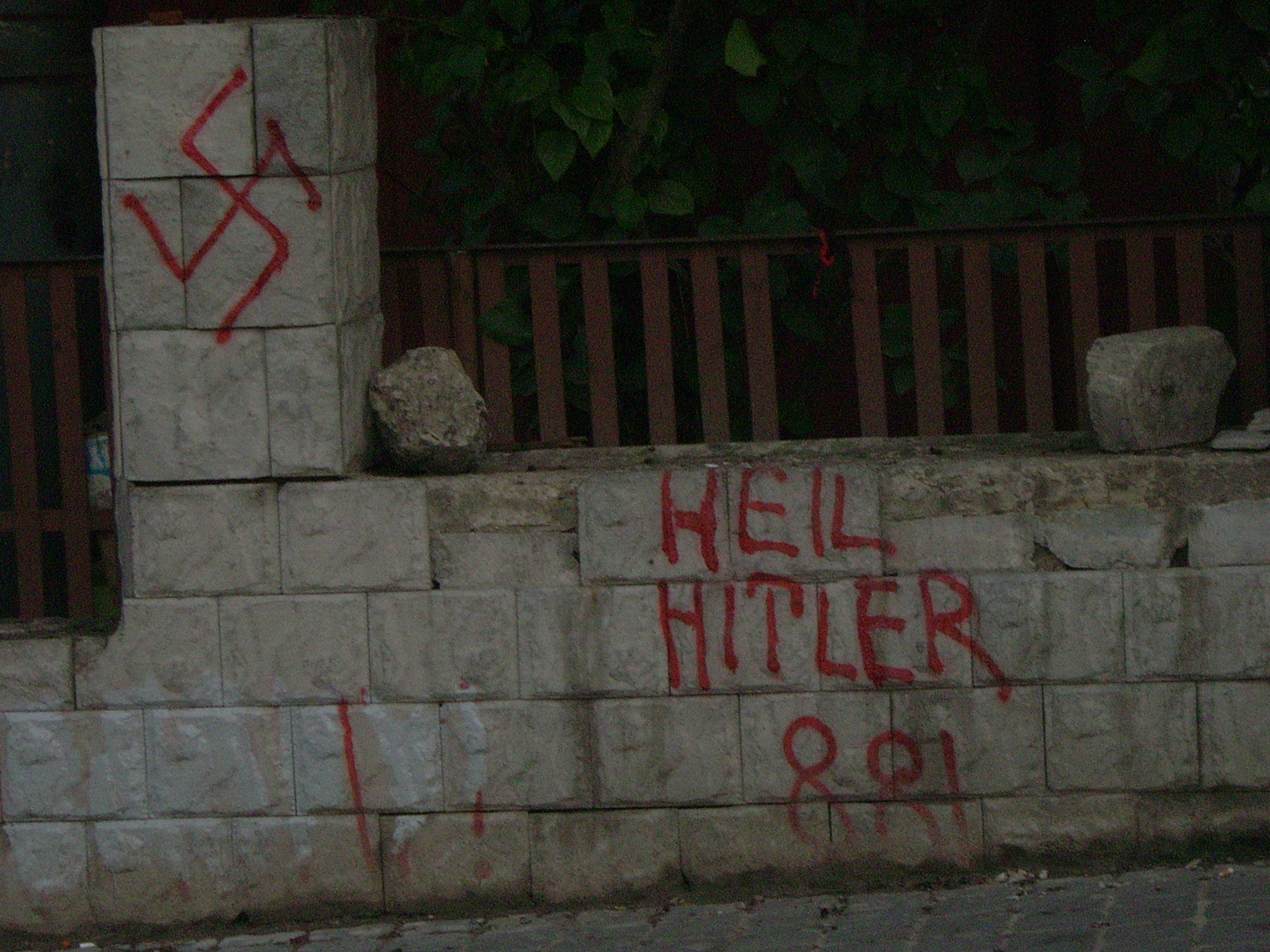
Contemporsry NAZI graffiti in the streets of Lutzk, Volhynia. August 2006. Photo: M. Lender.
And that’s the end of the story. Nothing remains as it was. About two years ago, on the initiative of the descendants of the survivors from Dombrovitsa—and primarily through the efforts of the local Lechovich family—a memorial to the town’s Jews was erected. The Lechovich family maintains and cares for the memorial.
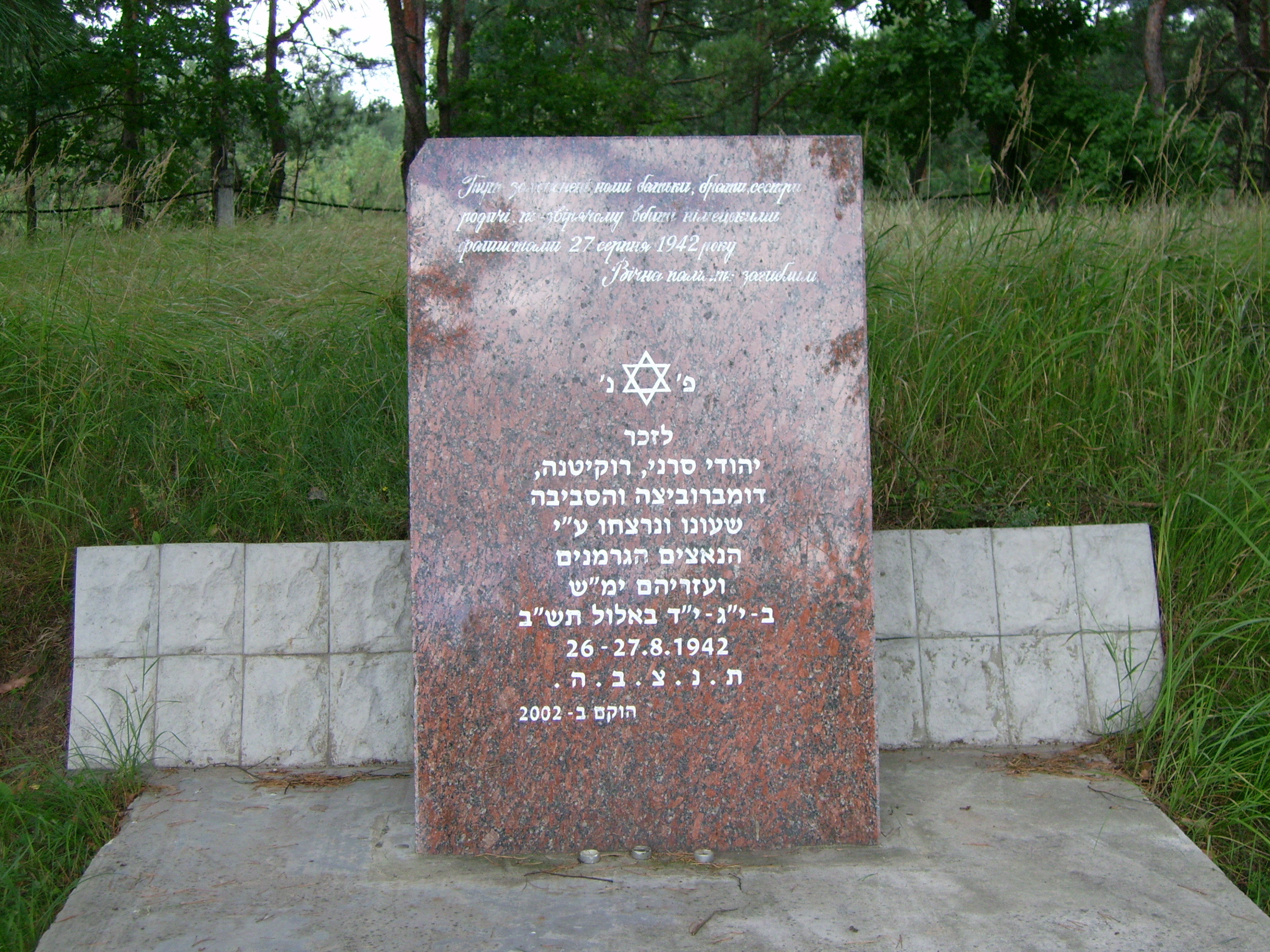
Memorial monument in Serny, erected 2002.
In the photos: The delegation to Ukraine. A photo of the village of Dombrovitsa taken from the old cemetery. The Horin River. Consulting with elderly women from the village to determine where things were. The path to the killing valley. The memorial stone in the killing valley. A photograph of the memorial erected in the town at the initiative of the Lechovich family and the descendants of the town’s survivors, and a painting of mine in which I tried to conjure up.
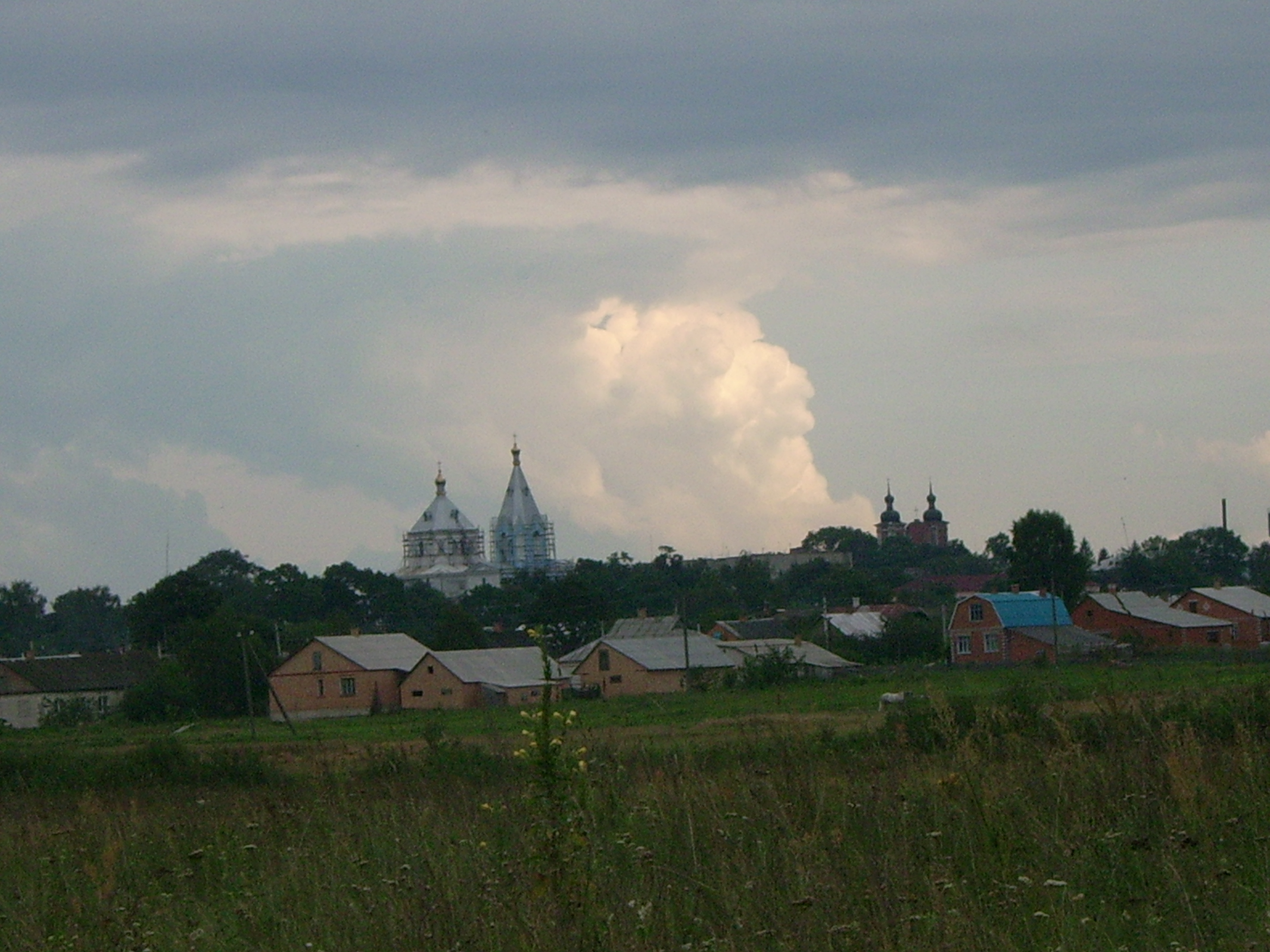
A photo of the village of Dombrovitsa taken from the old cemetery. The Horin River.
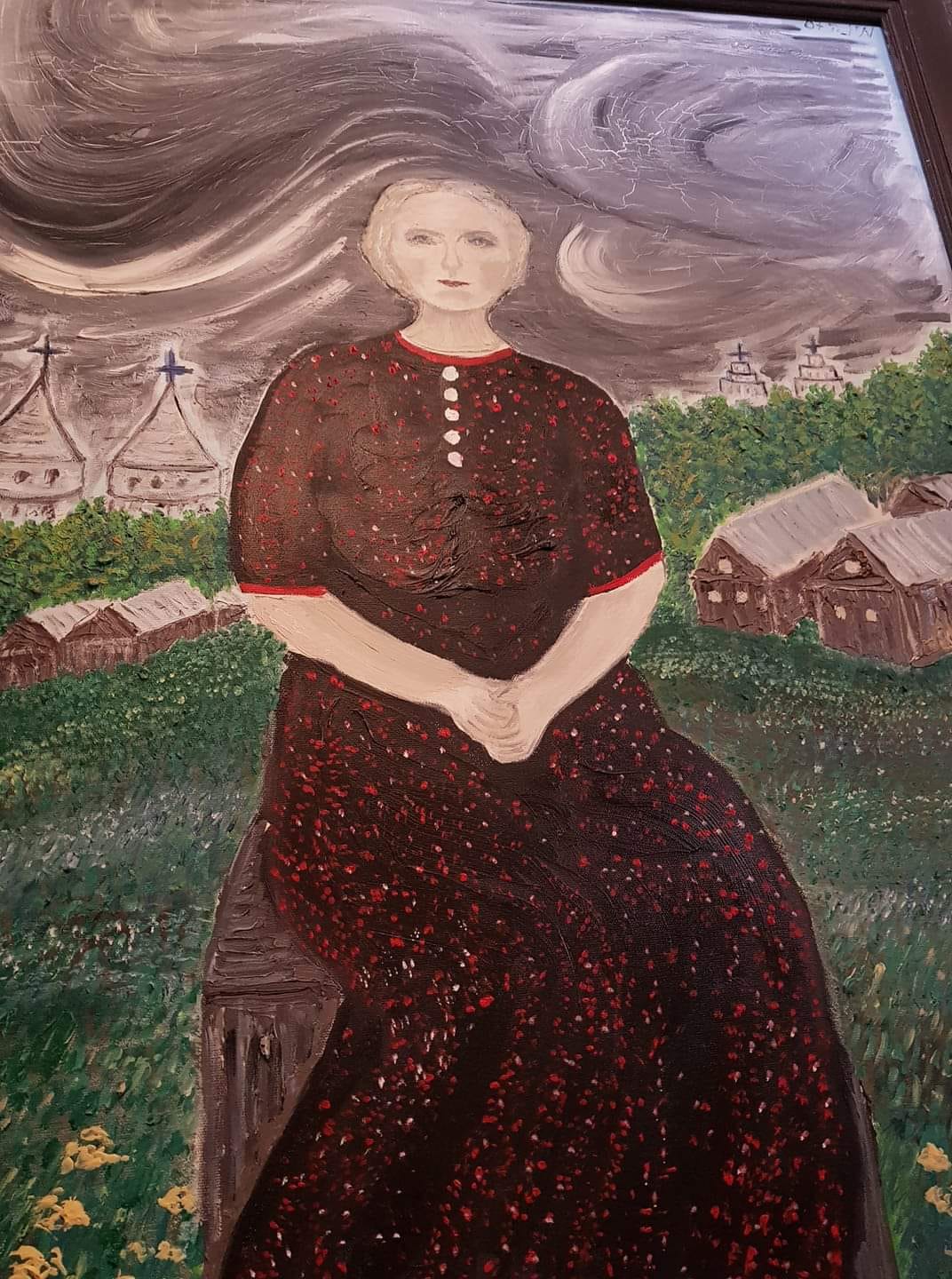
Mindel Vorona. Artistic painting by Minna Rozen
Grandma Mindel based on a single photograph of her against a backdrop of photos of her village.
(One of the few paintings I’ve done in oil rather than acrylic. 2006.)
https://en.wikipedia.org/wiki/Minna_Rozen https://www.mandylender.net https://minnarozen.co.il/


