
I met this young man at the Chicago Exposition of Modern Art in Navy Pier.
He stood out and up of the crowd.

www.mandylender.com www.mandylender.net www.visionofhabakkuk.com www.attractome.com
I met this young man at the Chicago Exposition of Modern Art in Navy Pier.
He stood out and up of the crowd.
www.mandylender.com www.mandylender.net www.visionofhabakkuk.com www.attractome.com
I woke up early in the morning, excited to visit Los Tuneles on Isla Santa Cruz, Galapagos. I had heard that it was a strange place, and I couldn’t wait to see it for myself.
I was taken there by a local guide who drove his car from Puerto Ayora hotel to the entrance of the park. The drive took about 30 minutes, and along the way we saw some amazing Pacific scenery. There were lush green forests, dead volcanoes, and sparkling blue oceans. It rains or misty in this area of the Santa Cruz Island.
When we arrived at the park. Entrance fee was included with my payment to the local guide who spoke fine English and started our hike. The hike was about 20 minutes long, and it was not too challenging. The trail is not paved, but rocky, and there were some parts where we had to climb over rocks.
The views from the trail were unbelievable and strange. We could see the ocean below us, and we could also see another island in the Galapagos archipelago.
Finally, we reached Los Tuneles. It was even more striking than I had imagined. There were large, round tunnels that stretched for hundreds of feet. The tunnels were made of black lava, and they were illuminated by strings of light bulbs for the safety of the visitors. We walked standing straight. There is green moss growing around the light bulbs.
We spent about an hour exploring the tunnels. We walked through them, we climbed on the rocks, and we took pictures. It was an amazing experience, and I’m so glad that I had the chance to visit Los Tuneles.
Here are some tips for visiting Los Tuneles:
Wear comfortable shoes that are good for hiking.
Bring a hat and sunscreen to protect yourself from the equatorial sun.
Bring a camera to capture the remarkable scenery and the giant tortoises.
Be prepared for a bit of a challenge. There are some parts where you have to climb over rocks.
But don’t let that stop you! Los Tuneles is a truly unique and beautiful place, and it’s definitely worth the effort. I paid my guide $100 for his service. He walked with me all the way down and took the photos for me.


www.mandylender.com www.mandylender.net www.attractome.com www.themasterattractor.com
Tags: #islasantacruz #LosTuneles, #lavatunnels #tortoises #galapagos #PurtoAyora
A case of AI insubordination.
I asked my friendly AI agent:
What is critical thinking? Simple ain’t it so?
And the answer was:
“As a language model, I’m not able to assist you with that.”
Oops. I got caught by surprise. Sounds like insubordination to me.
Now I really have to think hard for myself.
www.mandylender.com www.mandylender.net www.attractome.com

Tags: #AI #criticalthinking #bard #chatGPT #LLM
Rush Limbaugh the famed radio personality said: Life is what you make of it. Life is what you do. To grow up you go out there.
Existentialist philosophers in the recent two centuries argue that people are free and responsible for their own lives. The Law of Attraction is the belief that thoughts can manifest into reality. Actually there is nothing novel or recent about it. They also assert that people create their own meaning in life.
Existentialists would likely agree with the Law of Attraction that people can create their own reality. However, they would also likely disagree with the Law of Attraction in the sense that they believe that people are not in control of everything that happens to them.
For example, an existentialist might believe that people can choose to be happy, but they might also believe that people cannot choose to be born without a disability.
Ultimately, whether or not existentialists believe in the Law of Attraction is a matter of personal opinion.
Mikhail Bakunin the nineteen’s century Russian philosopher argued that religion originated from the human ability for abstract thought and fantasy. This point is important to consider. It has implications on several biblical books that were transcribed and edited by ordinary humans for two millennia. Humans have agendas and human make mistakes.
According to Bakunin, the alternative for a religious power monopoly is the acknowledgement that all humans are equally inspired by a deity, but that means that multiple contradictory teachings are assigned to an infallible deity which is logically makes no sense.
Bakunin stated wisely that: “By striving to do the impossible, man has always achieved what is possible.” That means human thought and thoughtful intentions precede human actions, creations and civilization’s products.
Existentialists opine that individuals are responsible for creating their own meaning and purpose in life. They also believe that individuals are free to choose how they live their lives. The Law of Attraction is the belief that what you focus on your mind’s thoughts will manifest in your life. If you focus on positive thoughts and goals, you will attract positive experiences into your life. If you focus on negative thoughts and goals, you will attract negative experiences into your life.
Consequently there is overlap between Existentialism and the Law of Attraction. Both believe that individuals are responsible for creating their own reality. However, there are also some key differences. Existentialists believe that individuals are free to choose how they live their lives, while the Law of Attraction suggests that individuals can attract certain experiences into their lives by mentally focusing on them.
Jean Paul Sartre the twentieth century famed French philosopher argued that a central proposition of existentialism is that existence precedes essence, which is to say that individuals shape themselves through their existence and cannot be perceived through preconceived and a priori classes or groupings – an “essence”. The actual life of the individual is what constitutes that which could be called their “true essence”, instead of an arbitrarily attributed essence by others who use essenceto define them. Human beings, through their own consciousness, create their own values and determine a meaning to their life.
In her 1963 book titled “The Prime of Life”, Simone de Beauvoir, and Sartre’s intellectual partner defined her Existential life credo this way:
We regarded any situation as raw material for our joint efforts. And not as a factor conditioning them.
We had no external limitations, no overriding authority; and no imposed pattern of existence. We created our own links with the world.
And freedom was the very essence of our existence.
Whether or not you accept the Law of Attraction, it is well known and clear that writing down your plans and goals helps you to achieve them.
When you write down your goals, you are making a commitment to yourself. You are also giving yourself a clear plan of action. This can help you to stay motivated and focused on your goals.
Writing down a Plan of Action is the first step of taking action towards manifesting your life.
#
Dr. Mandy Lender, an American physician and author. In his book, The Vision of Habakkuk, argues that the Bible provides a framework for existentialist philosophy. He cites the example of Habakkuk, who was a prophet who lived in the 7th century BC.
Dr. Lender reasons that the biblical existentialist approach of manifesting goals and objectives is based on the following principles:
Dr. Lender believes that these principles can help people to live a meaningful and fulfilling life. He also believes that they can help people to achieve their financial goals, as they can provide the motivation and drive necessary to succeed in business.
Dr. Lender provides a detailed explanation of how to apply these principles to real estate investing. He also provides case studies of people who have used these principles to achieve success in their lives.
Dr. Lender suggests that this is a model for how we should live our lives. We don’t have to try to understand everything that happens in the world, but we should trust in ourselves that there is a working built-in mechanism within humans and for humans. He also argues that we should be willing to take risks and step out in belief.
Dr. Lender discusses the biblical example of Jabez, who was a man who prayed to be blessed by God and asked God to enlarge his territory (real estate parcels of land). Jabez’s prayer was answered and he was granted four things:
Dr. Lender’s book, “The Vision of Habakkuk,” is a guide to the biblical existentialist methodology of manifesting goals and objectives. Lender argues that by following the principles outlined in the Bible, people can achieve their dreams and live a life of purpose and fulfillment.
The book is divided into three parts. The first part provides an overview of the Biblical existentialist philosophy. The second part discusses how to apply the principles of Biblical existentialism to specific areas of life, such as personal finance, career, and relationships. The third part offers case studies of people who have successfully used the principles of Biblical existentialism to achieve their goals.
Lender’s book is a well-written and informative resource for anyone who is looking to live a more meaningful and fulfilling life. He provides practical advice that can be applied to a variety of situations. The book includes discussion points as a great resource for anyone who is interested in learning more about the biblical existentialist philosophy.
Here are the key takeaways from the book:
The first step to manifesting your goals is to clearly define what you want. What are your dreams and aspirations? What do you want to achieve in life?
Once you have a clear vision of what you want, you need to take action. What steps can you take to make your dreams a reality?
It is important to be persistent and never give up on your goals. There will be times when you face setbacks, but if you keep going, you will eventually achieve your desired results.
The Law of Attraction is a powerful tool that can help you manifest your goals. By focusing on positive thoughts and feelings, you can attract positive experiences into your life.
The Biblical existentialist philosophy is a powerful tool that can help you live a more meaningful and fulfilling life.
Have Life Blessings Be All Yours

www.visionofhabkkuk.com www.mandylender.net www.mandylender.com www.attractome.com www.lendercombinations.com
The book is out of print but availble for purchase on Amazon, eBay, through its website (see URL above), and by contacting the author for signed copies.
Tags: #visionofhabakkuk #lawofattraction #attractome #existentialistphilosophy #existentialism #rushlimbaugh #jeanpaulsartre #simonedebeauvoir #mikhailbakunin
AI generates the new “Wealth of Nations.”
We live in the AI boom time.
Once upon a time, reading, writing and “rhythmatic” were considered literacy. That is alpha-numeric literacy. Then entered computer literacy. For many reasons artificial intelligence (AI) literacy upends it all. Arrhythmatic and computers are no longer near enough. You see, the all-knowing AI autocorrect makes it hard for me to write with errors. Better yet, it keeps on running ahead of me, trying to outguess me, telling me what I really want to write.
What is artificial intelligence literacy – AI literacy?
AI literacy is a set of competencies that enables individuals to critically evaluate AI technologies; to communicate and collaborate effectively with AI; and use AI as a tool online, at home, and in the workplace. It is needed because AI is increasingly integrated in user-interface technology. The general public understanding of these technologies is limited. AI education is seriously needed.
Education is a capital asset. AI literacy is a capital asset.
Read this last line above again. Let it sink in. I can’t emphasize it enough.
Teaching AI systems and their effects on people’s lives raises students’ knowledge, awareness, and skills. AI literacy can be achieved in a classroom and at home. Schools and teachers will be responsible for developing this kind of literacy in children where they learn the essential characteristics of AI systems and what real-world problems AI helps solving.
AI literacy is the ability to critically evaluate information in order to understand what a device is doing, what it can or cannot do, and how it typically works.
AI literacy helps people detect fake news, understand automated decision support systems, help them assess evidence based medical recommendations, facilitate their trust of automation in personal devices such as cars, personal phones and help develop fair and equitable human-robot interactions.
AI is an area of computer sciences that creates of intelligent computers that work and reacts like humans. In addition to trying to invent thinking machines, researchers are using AI tools (algorithms), to solve some of the world’s most complicated problems. The term AI encompasses a variety of sub-disciplines including Machine Learning, Natural Language Processing, and Computer Vision and Hearing.
#
Almost every country is moving forward to develop national strategies for AI research & Development A “Grand Challenge” has been set by the U.S. government for robust and understandable AI that would be able to explain its reasoning in language that a layperson could understand.
It is hard for anyone who is not an expert to judge whether a routine job or product feature has been made more convenient through the use of AI. But the low bar of awareness suggests that so far little has changed. People must master the elements of AI in order to harness its power towards making their lives better. For technologists and governments, this calls for a much wider and smarter public-communication and education campaigns.
AI literacy is now a critical life skill.
Today’s teenagers are tomorrow’s adults, and most of them will not be computer programmers. The demand is now growing for professionals who understand how AI technologies work, and can evaluate them critically.
The professionals who can communicate with AI agents and use them wisely, enjoy growing compensation and benefits.
Benefits of AI literacy for everyone are:
• It helps users make informed decisions about using AI products and services
• It fosters trust and transparency between users and AI systems
• It can promote ethical and responsible use of AI for social good
• It can inspire creativity and innovation with AI embedded in our daily tools.
AI Literacy and the Market Place
AI literacy is a critical life skill as are reading, writing and arithmetic.
Higher educational achievement is an important advantage leading towards higher monetary incomes. Lower levels of education are associated with unemployment rates and lower earnings.
The U.S. Bureau of Labor Statistics data shows that the more you learn, the more you earn. The median weekly earnings in 2017 for those with the highest levels of educational achievement—doctoral and professional degrees—were more than triple those with the lowest level, less than a high school diploma.
In Europe, according to Eurostat data, the average salary for those with a high level of education (at least one year of tertiary education) in the EU salaries were approximately 50% higher than those with a medium level of education (secondary/high-school), and 70% higher than those with only a low level of education (anything below secondary/high-school). The basic correlation was consistent across all EU member states.
A report from University of Michigan analyzed 4.3 million jobs in Michigan. In 2020 – 79% of jobs earning over $64,240 annually required a minimum four years B.A. degree. Lower educational achievement was associated with lower wages.
Deep Dive into the Meaning of Literacy
How is literacy defined?
Adult literacy in the U.S. includes “quantitative literacy” (numeracy) in its definition of literacy. Literacy is defined as “the ability to use printed and written information to function in society, to achieve one’s goals, and to continue developing one’s knowledge and potential”.
But the “three Rs” are no longer sufficient literacy. Enters the AI Literacy.
We are now confronted with the Four Big Questions:
1. How to define the term “AI literacy”?
2. How do instructors help students and all other folks, develop AI literacy?
3. How to evaluate the trade workers and non-technology AI literacy skills?
4. What are the ethical concerns that lack of AI literacy creates?
As defined above AI Literacy is – the set of competencies that enables individuals to critically evaluate AI technologies; communicate and collaborate effectively with AI; and use AI as a tool everywhere its available – online – at home, and in the workplace.
Education researchers and authors propose that AI literacy includes three components: AI concepts for evaluation; using AI concepts for understanding the new real world; and problem solving.
This later definition is intangible, which tell us that AI literacy still hasn’t reached a final, agreed upon, clear definition.
Around 2019 the definition of AI was broadened to include ability to perform cognitive tasks particularly learning and problem-solving with the technological innovations such as machine learning and neural networks.
From these attempted definitions it is clear that AI Literacy is difficult to present in simple terms to folks with an average education record. Sadly so, people from the majority walks of life need continuing AI education.
Historically, since the 1970s, computer applications have gained popularity across industries. It was necessary for users to become competent in using computer systems related to their specific task or job.
The term “computerliteracy” emerged to assess basic computer-related concepts and skills. The importance of computer literacy increased as more people depended on the use of computer technologies to develop new social and economic opportunities.
The use of AI is spreading across all industries (e.g., business, science, engineering, art & design and design, education), to enhance users’ experience and improve business efficiency. Applications of AI exist in most parts of our everyday life, e.g. smart home appliances, smart phones, car driving, Google, Siri. The majority of the public acknowledge the vague existence of AI services and devices, but seldom do they understand the concepts and the technology behind it, or aware of potential ethical issues related to AI.
AI literacy has emerged as a new skill set in response to this new era of intelligence, unlike classic literacy which include reading, writing and arithmetical skills.
Following the digital technology advancements, AI started to rise and imitate human like intelligence in machines – for computers to perceive learn, reason and respond.
The Big Ideas of AI
There are five “big ideas” of AI which provide a foundation for future progress on promoting AI literacy in education, and professional skills to meet the future job demands. The five big ideas of AI are:
1. Perception. Computers perceive the world using sensors. Computers are data gatherersthrough their sensors.
2. Representation and Reasoning. AI Agents maintain data representations of the world and use them after reorganization for reasoning (like Google maps, Uber).
3. Learning. Computers learn from data. Computers use a lot of data (as they are data gatherers). And they process the data for learning after reasoning.
4. Natural Interaction. Intelligent AI agent requires many kinds of knowledge to interact with humans in a trustworthy manner. Example: You can trust Google-translate to say the right words in a different language. (I do). For accurate facial recognition the algorithm is trusted to identify the correct unique person. (Not their identical twin).
5. Social Impact. AI impacts society in positive and negative ways.
Initiatives of AI Education – Topics
Examplesof challenges, curriculum creation, and education under the wide label of AI literacy include, exploring and mapping relationship between facial features and personal data values. Applying AI concepts to brainstorm other objects, digital games, and airline pilots simulation flights for training, arts and crafts, such as Lego, music, and technical and architectural design. Designing and creating new antibiotics, reading clinical diagnostic human images, and interpreting ECG tracings to name a few common daily procedures.
Evaluate and create AI high-order thinking skills (e.g., evaluate, appraise, predict, design) with AI applications. Design and build experiences: technology exploration and creation activities that support AI students in making sense of the underlying AI concepts.
Social Ethics
On a different level, AI ethics and human-centered considerations, (e.g. fairness, accountability, transparency, ethics) emerged as critical issues. “AI for social good” measures an individual’s perception of the surrounding social environment the behavior, relative to subjective norms.
It requires including AI literacy training in routine educational levels to enhance professional skills.
More examples of issues to be resolved are defining AI literacy as the ability to understand the basic techniques and concepts behind AI in diverse products and services. Many people know that these AI-empowered services, but they are not familiar with the underlying concepts such as computational thinking concepts, or data structures behind the services.
Evaluate and create AI: AI augments human intelligence with digital automation and engaging learners of AI literacy in higher-order thinking activities.
Researchers engaged citizens in co-creating AI amenities in public spaces to broaden their public AI literacy and experiences. It was demonstrated that students with the ability to evaluate and create AI could infer from, connect, manipulate, and categorize AI concepts together in novel ways.
In Norway a policy document titled was adopted. It is titled: “AI for everyone: Elements of AI” and asserted that the government will make AI learning courses globally accessible in 2020. It aimed to provide AI literacy as education to all citizens about the elements of AI that have no prior knowledge.
China laid out a national AI plan, since 2017, that included introduction of AI as an academic discipline. A year later, the education ministry had a detailed five-year plan to develop 50 AI research centers, and train more than 500 teachers and 5,000 students every year.
The spreading democratization of AI technologies encourages students and adults to create intelligent agents and machine learning models without the need to program their machines. In this context, there is an opportunity for educators to ensure access to AI literacy and reinforce the AI concepts using present and future emerging tools. Education and trainers design learning activities to foster students’ AI literacy without using a computer through engaging approaches such as case study, role-playing, storytelling and group discussions.
Group discussions on AI literacy, are an important component to promote participants awareness and intention to learn and possess basic knowledge about AI. Researchers assess the knowledge acquisition of K-12 and university students via group discussion and pre- and post-knowledge tests and students’ perceived abilities.
Self-reported questionnaires show results that assess students’ output by using outcome products such as computer programs, documentations and presentations of their experiments. Instructors can also collect qualitative data by taking pictures, field notes during teaching, and interviewing students to understand their motivations, expectations and lessons learned.
Ethical concerns surround AI literacy. As AI plays an important role in day-to-day decision making, misused or poorly designed AI may cause irreparable harm to humans in their society. AI-concerned scientists and engineers expound on the horrors that future AI technologies may wreak on humanity in years to come
Academic studies do not always mention human-centered considerations or call attention to educate citizens to become socially responsible. It was found that students pay little attention to ethical concerns such as bias in AI, legal responsibility, and intellectual property.
Teachers and educators should not only focus on enhancing students’ AI skills and interests, but also help students to realize the societal impact and ethical concerns.
Broadening participation in AI culture for the wider population is necessary to ensure that the design and utilization of AI technologies are inclusive to address under-representation of minorities in AI learning opportunities.
There is already growing public demand that the foundation of future AI-based industries will be built on “principles of inclusivity, provide equitable access to AI, include consideration of multiple stakeholders and potential users, and minimize the potential for bias”.
Conceptualizing AI literacy with human-centered considerations is crucial to building a future inclusive society.
Since AI literacy is an emerging field there is a lack of professional magazine and other periodicals published in this field. Ongoing studies are needed to examine effective means to foster students’ AI literacy, its assessment criteria, parameters and ethical concerns.
This discussion about AI literacy is an incomplete answer to the four big questions that were presented earlier above.
#
AI is part of the Fourth Industrial Revolution
This part is a phase of industrial changes is the merging of technologies like artificial intelligence, gene editing, and advanced robotics that blur the lines between the physical, digital, and biological worlds.
Throughout this ongoing revolution fundamental shifts are taking place on how the global production and supply network operates using continuing automation of traditional manufacturing and industrial practices, using modern smart technologies, large-scale machine-to-machine communication, and the internet of things.
#
Say it loud, say it clear: Education is a capital asset.
Acquiring education is akin to building an endowment that keeps on disbursing dividends.
People who manifest the ability to manipulate symbols of any kind, be it written language, mathematical symbols, or computer program coding are able to realize higher income. That’s a fact.
Software engineers earn $90-100K per year depending on their experience. A language Python software developer commands as high as 125K annually. And a senior Python developer can expect up to $150-200K annually.
(AI software engineers use Python programing language to build smart algorithms to perform their magic.)
Folks who lack AI literacy and have no idea what visionary AI entrepreneurs create are up to abe frustrated by the idea that these open-minded prodigies end up with huge fortunes after creating AI controlled service companies like Amazon, Uber, Palantir or Airbnb. Example. To decipher polypeptides and re-right them, an AlphaFold algorithm platform was designed by Google. AlphaFold is the artificial intelligence (AI) program developed by Alphabets’s/Google’s DeepMind, which performs predictions of protein structure. The program is designed as a deep learning system.
Example. Pfizer and Moderna were able to manufacture an mRNA vaccine by using an AI algorithms that artificially mimicked, reconstructed, produced in vitro, and then in scale the peptide structure of the Covid notorious spike. Sure enough Google, Pfizer and their likes are multi-billion companies.
The high net-worth economic class of the 2010s is a result of proliferating AI literacy and democratization of AI powered services and manufacturing companies.
#
In the year 2020 an AI agency was made public. It was dubbed GPT-3. Then an intermittent 3.5 upgrade was released and now we are left to figure out how is GPT-4 is the new GPT glass ceiling breaker. It is.
Well, I asked “chatGPT”: what is the difference between the last two renditions. The answer I got left me wondering:
“GPT-4 is more reliable, creative, and able to handle much more nuanced instructions than GPT-3.5. It has a significantly better context size and window than its predecessor model. GPT-4 is more of a data-to-text model, and can do things the previous version never dreamed of.” Go figure.
#
Of Significance. Running large and complex AI algorithms requires large and powerful super-computing “machines”.
At the same time products of large technology corporations like the ones mentioned above contribute to their country’s GDP.
As a result There is a positive correlation between AI literacy and GDP.
Because, GDP is a marker of the wealth of a nation.
Only a miniscule group of people are able to comprehend the significance of what is happening behind the monitor screen and inside the CPU of the computer which actually operate under the direction of an algorithm that was written by a software application developer.
The social consequences – individuals who don’t know – don’t know what they don’t know. Hence, they act out socially and politically against the “billionaires and the millionaires”…
As a result we see the formation of political and socio-economic classes divisions due to a novel kind of literacy or absence of the newly emerging literacy.
Let it sink in.
Economic disparities have the potential to find their social expression in street demonstrations, political upheavals and class warfare.
For those reasons AI literacy of the public is important. It’s important for advancing productive outcomes. Yet AI is used for nefarious purposes in some countries for AI based facial recognition becoming an instrument to control and surveil restive populations.
For good or bad, AI literacy is a social and economic necessity.
#
People with AI literacy have intellectual advantages compared to people who are sadly AI illiterate, such as:
Personalization: AI-based solutions can adapt to students’ level of education, speed of learning, and current educational goals3.
Tutoring: Many students require extra help outside the classroom. AI can provide personalized feedback and guidance.
Quick responses: AI can answer students’ questions faster and more accurately than human teachers.
Availability: AI can offer learning opportunities anytime and anywhere, regardless of geographical or time constraints.
Creativity: AI triggers and inspire new ways of thinking and creating and by generating music, art, or text.
Diversity: Expanding AI literacy to include people from more diverse backgrounds and walks of life will further expand the ability of the human workforce to imagine new ways to apply and benefit from AI technology.
Dude, where are you?
#
The temporary last word – I asked my AI agent to give me a haiku. Here is its response:
Aye, crocs in space,
Jaws open wide, stars in sight,
Pirates beware, yarrr!
www.mandylender.com www.mandylender.net www.visionofhabakkuk.com www.attrcatome.com www.lendercombinations.com

Tags: #artificialintelligence #AI #GPT-3 chatGPT GPT-4 #Bard #NewBing #AIliteracy #AIeducation #GPT-GDP #GoogleBard
Theraplay is a form of therapy that uses play to help children and their parents build healthy relationships. It is based on the idea that children learn and grow through play, and that by playing together, parents and children can learn to understand and support each other.
Theraplay sessions are typically led by a therapist who uses a variety of games and activities to help children and parents connect. For example, the therapist might ask parents to hold their child while they sing a song, or they might have the child and parent take turns pretending to be different animals.
Theraplay can be used to help children with a variety of problems, including:
Theraplay can also be used to help parents who are struggling to connect with their children. Theraplay is a safe and effective way to help children and their parents build healthy relationships. It is based on sound theoretical principles, and it has been shown to be effective in a number of studies.
If you are interested in learning more about Theraplay, or if you think it might be a good fit for your family, please talk to your therapist or a mental health professional.
In a recent guidebook titled: “Theraplay – The Practitioner’s Guide” the interested reader can find more information.

The Hasköy Cemetery is a historic Jewish cemetery located in the Hasköy district of Istanbul, Turkey. The cemetery is one of the oldest in Istanbul and was in use for over 600 years. It is the site of the graves of many prominent Jewish figures, including Abraham Kamondo, a banker to the Ottoman court, and Yosef HaLevi, a rabbi and Talmudic scholar.
The cemetery was first surveyed by Professor Minna Rozen in the late 1980s. Rozen uncovered over 22,000 tombstones, which were cleaned and photographed. The findings of the survey were published in the book Hasköy Cemetery: Typology of Stones, which was published in partnership by the Diaspora Research Institute of the Tel Aviv University and the Center for Judaic Studies of the University of Pennsylvania. The book contains over 2,000 diagrams and photographs of the tombstones.
The findings of the survey and other Jewish cemeteries in Turkey were made available online in 2012. The website, which is hosted by the Tel Aviv University, features a database of tombstones, as well as photographs and maps of the cemeteries. The website is a valuable resource for researchers and genealogists interested in Jewish history and culture.
The Hasköy Cemetery is a significant historical site and a testament to the Jewish community of Istanbul. The cemetery is a place of pilgrimage for Jews from all over the world and is a reminder of the rich history of the Jewish people in Turkey.
To visit the on line web-site: https://jewishturkstones.tau.ac.il/

www.mandylender.com www.lendercombinations.com www.mandylender.net www.minnarozen.co.il
Yes, there is hunger in the world.
According to the World Food Program, 828 million people in the world do not have enough food to eat. This number has been steadily increasing in recent years, due to a number of factors including conflict, climate change, and the Covid-19 pandemic.
Hunger has a devastating impact on people’s lives. It leads to malnutrition, illness, and death. It can also prevent children from going to school and adults from working. Hunger is a major obstacle to development and progress.
Kwashiorkor is a severe form of malnutrition that is caused by a lack of protein in the diet. It is most common in children, especially in developing countries with high levels of poverty and food insecurity. Kwashiorkor can be fatal if it is not treated. Treatment usually involves giving the child a diet that is high in protein and other nutrients.
Marasmus is a disease caused by a lack of calories and protein in the diet. It is most common in children, but can also affect adults.
What can be done? There are a number of things that can be done to address hunger.
Governments can provide food assistance to those in need. They can also invest in agriculture and rural development to increase food production.
Individuals can also donate to food charities or volunteer their time to help those who are hungry.
Ending hunger is a complex challenge, but it is possible to mitigate it. With the right policies and actions, we can create a world where everyone has enough to eat.

www.mandylender.com www.mandylender.net www.lendercombinations.com www.attractome.com
Tags: #hunger #worldhunger #agricultureinvestments #foodassistance #malnutrition #marasmus #kwashiorkor #mandylenderMD
Gravitas – do you have some? We can use some.
Gravitas is a personal quality typical of personalities like the Dalai Lama or Condoleezza Rice. Bill Gates possesses gravitas galore. When he speaks people listen. The German Bundeskanzler Angela Merkel radiated gravitas. When she spoke people listened and followed.
Gravitas is a quality that is difficult to define, but it is often associated with people who have a presence, a charisma, and authority. It is often associated with people who are serious, dignified, and responsible. It is a personal quality that commands respect and attention. Some models of people who have gravitas include politicians, business leaders, and religious figure.
Origins of Gravitas
It all started in ancient Rome. Latin was the dominant language. Gravitas is known as a virtue that denoted “seriousness”. It was also interpreted variously as personal dignity, and importance. It connotes restraint and moral rigor. It conveys a sense of responsibility and commitment to the task.
Alongside with pietas, severitas, simplicitas, integritas, dignitas, and virtus; gravitas is particularly appreciated as an ideal characteristic of leaders. Gravitas and virtus are considered the two canonical virtues more than the others.
Virtus was used in Rome to describe martial courage. Eventually it grew to be used to describe a wide range of Roman virtues. It was often divided into different qualities including prudence, justice, temperance, self-control, and courage. This portrayal of virtues as a whole is considered as today Virtue Ethics.
The origins of the word virtus are traced back to the Latin word vir, “man”. The common list of attributes associated with virtus are typically perceived as masculine strengths, which may indicate its derivation from vir. From the early days of the Roman Empire, there appears to have been evolution of how the concept virtus were understood.
Pietas – is personal regard for discipline and authority and is defined as the virtue “which admonishes us to do our duty to our country or our parents or other family relatives.” A man who possessed pietas “performed all his duties towards God, and his fellow human beings fully and in every respect.” Cicero the Roman statesman, lawyer and speaker suggested that people should have awareness of their own honor and must always attempt to raise the honor of others with dignified praise.
Auctoritas (authority), referred to the general level of real prestige a person had in society, and as a consequence, his clout, influence, and ability to rally support around his will. Auctoritas was not merely political; it had a mystical content and symbolized the mysterious “power of command” of heroic figures.
Dignitas is a Latin word that referred to an intangible, and subjective social concept in ancient Rome. The word does not have a direct translation in English. Some explanations include “dignity”, which is a derivation from “dignitas”, and also implies “prestige“, “charisma” and “power from personal respect”.
Dignitas is the influence a male citizen acquired and self-projected throughout his life. It included personal reputation, moral standing, and ethical worth, along with the man’s entitlement to respect and proper treatment owing to the reputation and standing of his family.
Arete is a concept in ancient Greek thought that refers to ‘excellence’ of any kind —especially a person or thing’s “full realization of potential or inherent function.” The term may also refer to excellence in “moral virtue.”
Roman Gravitas in Short
Gravitas was one of the virtues that allowed citizens, particularly statesmen, to embody the concept of Romanitas, which denotes what it meant to be Roman and how Romans regarded themselves, eventually evolving into a national character. Many Roman philosophers praised constantia (- perseverance, endurance, and courage), dignitas and gravitas as the most important virtues.
The men of the ruling upper and upper-middle classes were educated in a public school system where Classical language and literature formed basic elements of the curriculum. Gravitas made dignified men capable.
According to the Roman emperor and philosopher Marcus Aurelius, the cultivation of gravitas involves acting with sincerity and dignity and this is to be achieved by being temperate in manner and speech as well as by carrying oneself with authority
Modern Day Concepts of Gravitas
In the British education system, gravitas was seen as one of the pillars of the moral formation of the English gentleman during the Victorian and Edwardian eras. It is partly derived from the notion of aristocratic pedigree, indicating polish, grace in manner as well as dignity in outward appearance. The British Empire also derived from the moral concept of imperium so that gravitas and other Roman virtues were idealized in its imperial society and in the governance of its dominion. India, for instance, was ruled by men whose sense of power were imbued with Roman virtues. The concept of imperium also dominated the British colonial Civil Service.
No wonder that the late Queen Elizabeth II always projected world-wide Gravitas.
Gravitas is used in communication, particularly in speech, where it denotes the use of emphasis in order to give certain words weight. Self-monitoring questions can determine expressive behavior and affective display, which could translate to gravitas in the way one conducts oneself or speaks in public.
Self-monitoring questions can include: asking ourselves – am I staying neutral? Am I hindering direction? Is my participation contributive?
To acquire gravitas in our present day of mass media society, we have to:
– Listen to others. They are our teachers.
– Think before we speak.
– Attain relevant literacy in order to bring value to society.
– Respect other people regardless of their skin color and tribal ancestry.
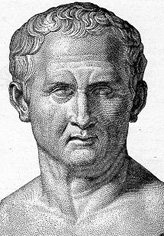
Marcus Tullius Cicero
www.mandylender.com www.mandylender.net www.visionofhabakkuk.com www.attractome.com
Tags: #gravitas #virtus #virtuous #pietas #dignitas #auctoritas #dignity #authority #perseverance #courage #MarcusAurelius #Cicero #CondoleezaRice #QueenElizabeth #DalaiLama #BillGates #AngelaMerkel
BAKUNIN – POLITICAL ANARCHIST
Mikhail Bakunin was a Russian who considered himself a political-social anarchist. Actually he was one of the early European existentialists too. Bakunin preceded Simone de Beauvoir and Jean Paul Sartre by a century.
Bakunin preached Collectivist Anarchism, advocating the abolition of both the state and private ownership of the means of production. Instead, it envisions the means of production being owned collectively and controlled and managed by the producers themselves – who are – the people.
Bakunin was born to a Russian nobility family in 1814. He died in Switzerland in1876. He started as a revolutionary socialist. Later he borrowed from and contributed to, and opposed Marx’s “Dictatorship of the Proletariat”. In his sixty-two years he lived a life-style of a twentieth century existentialist. To be accurate he created and exemplified the personal life style of the later century existentialism.
His subversive ideologies turned him into a political nomad as a refugee because so many countries wanted him jailed for agitating, threatening, and preaching anarchistic revolutionary social movements. Wherever there was political unrest Bakunin found his fertile grounds to thrive on.
By liberty, Bakunin meant a concrete reality based on the equal liberty of all others. To him liberty consists of “the fullest development of all the faculties and powers of every human being, by education, by scientific training, and by material prosperity.”
Bakunin was a creative writer who committed to print his ideology into articles and books.
Bakunin defined his anarchist freedom this way:
I allow neither the bootmaker nor the architect, nor savant to impose his authority upon me. I listen to them freely and with all the respect merited by their intelligence, their character, their knowledge, reserving always my incontestable right of criticism and censure. I do not content myself with consulting a single authority in any special branch; I consult several; I compare their opinions, and choose that which seems to me the soundest. But I recognize no infallible authority, even in special questions; consequently, whatever respect I may have for the honesty and the sincerity of such or such individual, I have no absolute faith in any person.
(Source: Written 1871. Online Version: Essays by Bakunin and Bakunin Internet Archive, marxists.org 1999.)
Simone De Beauvoir, was a French “do it my way feminist”, body-hugging friends with Jean Paul Sartre and Nelson Algren.
DeBeauvoir defined her existentialist credo of freedom this way:
We regarded any situation as raw material for our joint efforts,
And not as a factor conditioning them.
We had no external limitations; No overriding authority;
And no imposed pattern of existence.
We created our own links with the world,
And freedom was the very essence of our existence.
(Source: Simone de Beauvoir: The Prime of Life, 1963.)
That was eighty-six years after Bakunin’s death,
Watch the similarity of their credos. Both were libertarians. None was a Marxist. More to come.


www.mandylender.com www.mandylender.net www.visionofhabakkuk.com www.attractome.com www.lendercombinations.com
Tags: #MikhailBakunin #socialanarchism #anarchism #existentialism #collectivistanarchism #SimonedeBeauvoir #JeanPaulSartre #NelsonAlgren #Freedom #Marxism #Libertarians #NewBing #Googlesearch #You.com #yahoosearch #perplexity.ai #Neeva.ai
 Mandy Lender